En esta página
Before bundling, the real question is not "will shipping multiple items together always be cheaper," but rather: after recording the item prices, packaging dimensions, chargeable weight, service fees, payment costs, and destination country charges under the same conditions, does bundling still offer a clear advantage? This article provides a verifiable calculation method for buyers who plan to discover products on the Fashionreps page and then place orders and ship t
Por Nathan ColeNathan Cole is Editor-in-Chief, covering residential and commercial lighting specification, LED driver behavior, illuminance and color measurement, and dimmer compatibility. They write most bulb and fixture reviews, keep the paper calibration log, and sign off on every final score. The bench protocol covers three illuminance distances, spectrometer readings at full, mid, and low dim, and a photodiode flicker run on the dimmer wall before scoring discussion. Every scored product requires a 30-day in-room period, and Nathan finalizes a score only when two of the three editors agree on the bench record.
Before bundling, the real question is not "will shipping multiple items together always be cheaper," but rather: after recording the item prices, packaging dimensions, chargeable weight, service fees, payment costs, and destination country charges under the same conditions, does bundling still offer a clear advantage? This article provides a verifiable calculation method for buyers who plan to discover products on the Fashionreps page and then place orders and ship through a shopping agent.
First, let's clarify the applicable boundaries: the Fashionreps page is responsible for product discovery, product information display, and shopping agent entry; orders, payment, warehousing, inspection, packaging, international shipping, customs clearance, and after-sales are handled by the selected agent or carrier. This draft records the reference prices and category information visible on the page, which do not equal the final settlement price, and cannot independently prove inventory, packaging dimensions, actual weight, or route fees. 🧮

The specific decision this foreign trade accessories bundling calculation aims to solve
After reading, a buyer should be able to complete one specific action: split the intended purchase into a separate shipping plan and a bundled plan, and compare the total cost under the same destination country, currency, declaration conditions, packaging requirements, and service scope.
This method does not apply to the following situations:
- No clear destination country, receiving area, or currency.
- Only know the listed price on the product page, but do not know whether the agent charges service fees, storage fees, inspection fees, or packaging fees.
- Need special packaging, battery shipping, liquid shipping, brand restrictions, or other services affected by the route.
- Still waiting for inventory, size, specification, or seller confirmation of shipping.
- Trying to reduce costs through under-declaration, order splitting to avoid taxes, or evading inspection. Such practices should not be considered part of the calculation plan.
The bundling decision should record three outcomes: estimated savings, increased risks, and under what circumstances bundling should be abandoned. Writing only "bundling is more cost-effective" is an incomplete conclusion.
Recording the item price, specifications, and links for each accessory from the Fashionreps page
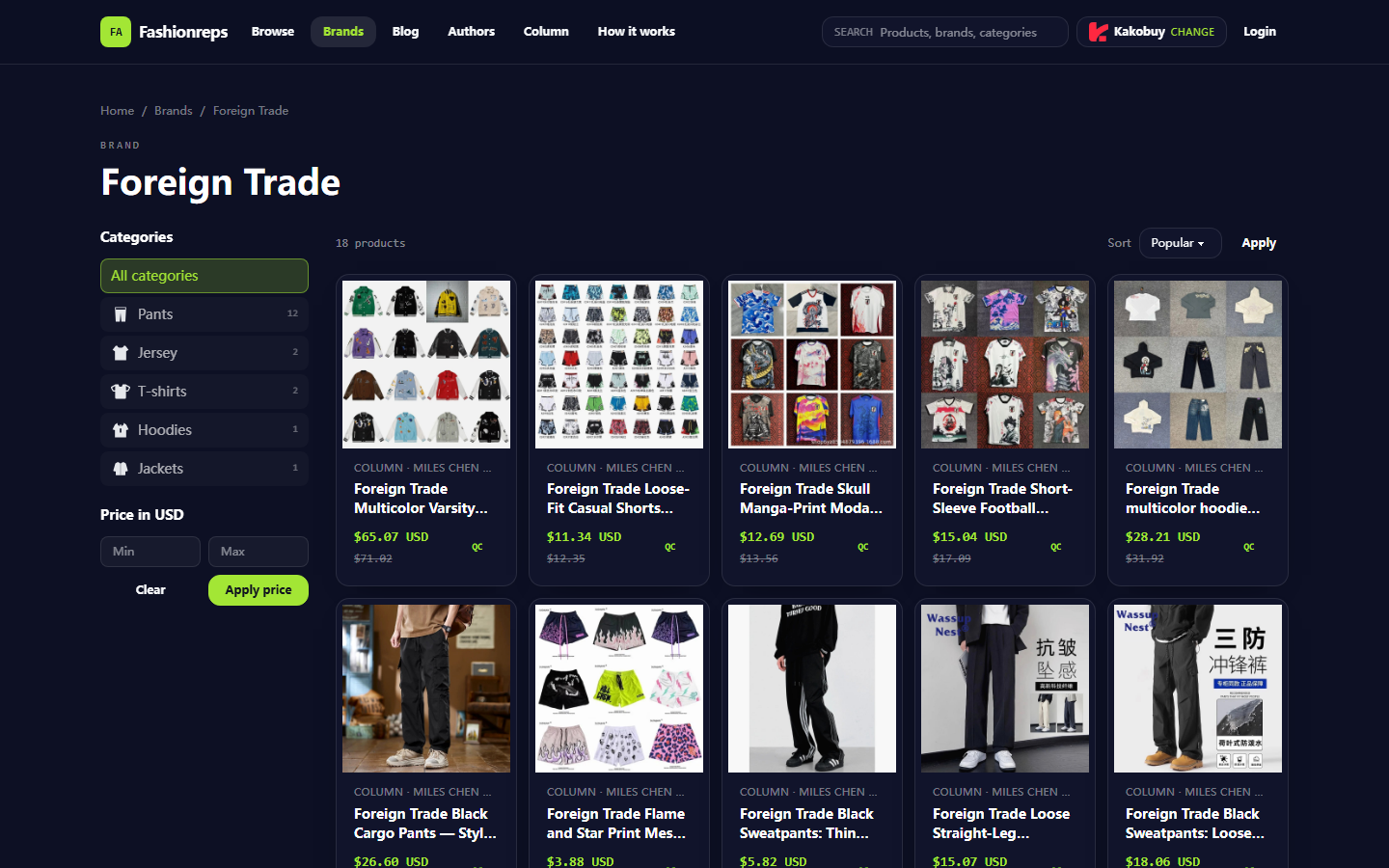
The Foreign Trade category page on Fashionreps shows 18 items, and the visible categories include pants, jerseys, T-shirts, hoodies, and jackets. The page displays reference prices and also lists previous reference prices; this information can serve as input for product discovery and initial budgeting, but cannot replace the agent's settlement page.
In this page record, some products and their visible reference prices are as follows:
| Product record | Visible reference price | Previous reference price shown | Use in calculation |
|---|---|---|---|
| Multicolor Varsity Jacket Collection With Ten Colorways and a Loose Fit | 65.07 USD | 71.02 USD | Initial budget for item price |
| Loose-Fit Casual Shorts Listed in XS–4XL and About 30 Colorways | 11.34 USD | 12.35 USD | Initial budget for item price |
| Skull Manga-Print Modal Training Set in 55 Numbered Colorways | 12.69 USD | 13.56 USD | Initial budget for item price |
| Short-Sleeve Football Training Jersey in S–3XL and 40-Plus Team Colorways | 15.04 USD | 17.09 USD | Initial budget for item price |
| Brown T-Shirt: Loose-Fit Pure Cotton Summer Crew Neck with Cartoon Print | 5.97 USD | 6.83 USD | Initial budget for item price |
| Black Athletic Shorts: Polyester Five-Point Cut in Street Style | 7.46 USD | 8.51 USD | Initial budget for item price |
When recording, do not only copy the title and price; also keep the following fields for each item:
- Product name, product page URL, and page verification date.
- Specification information, such as size, color, style number, and available versions.
- Whether the page reference price and discount price are clear, and the currency corresponding to the price.
- Whether the product status is accessible, has a clear name, and enough visible information to support ordering decisions.
- Whether it is necessary to wait for inventory, seller confirmation, or further agent quoting.
- Whether there are differences between page images, product descriptions, and actual order information.
If the target is accessories, but the current category page has no verifiable accessory product samples, do not forcibly rewrite clothing products as accessory evidence. In that case, you should first supplement with real accessory pages, or clearly limit the sample scope in the article to clothing products under the Foreign Trade category.
What package conditions need to be unified for separate orders vs. bundled plans
Before comparing, establish two plan rows: separate shipping and bundled shipping. Both rows must use the same destination country, same receiving area, same currency, same declaration basis, and comparable shipping services.
At least unify the following conditions:
- Product list. Both plans include exactly the same products and quantities.
- Warehouse handling scope. Whether both include inbound inspection, verification, repackaging, photography, or other optional services.
- Packaging objectives. Whether to remove excess outer packaging, retain product boxes, or use reinforcement materials.
- Shipping route. Do not directly compare an economy route for separate packages with an express route for bundled packages.
- Billing rules. Confirm whether the carrier charges by actual weight, volumetric weight, or the greater of the two.
- Declaration conditions. Product value, category, quantity, and destination requirements should be truthfully declared.
- Time window. Storage days, promotion validity, route suspensions, and holidays may affect results.
The potential advantages of bundling usually come from reduced fixed operating fees, reduced repeated first weights, or improved packaging space utilization; potential costs include higher volumetric weight, concentrated total package value, route restrictions, and increased exposure to loss in a single shipment. Without same-condition quotes, you can only write "potential savings," not "definitely cheaper." 📦
How to record packaging method, volume, chargeable weight, and service fees in separate columns
Packaging and shipping costs should be recorded separately; do not treat a single total from the agent's quote directly as shipping cost. It is recommended to establish the following fields:
| Cost or condition | Separate shipping | Bundled shipping | Basis that must be confirmed |
|---|---|---|---|
| Item price | Sum per item | Sum per item | Product page or agent order page |
| Packaged length, width, height | Record each package separately | Re-measure after bundling | Warehouse measurement or agent quote |
| Actual weight | Record each package separately | Re-weigh after bundling | Warehouse weighing record |
| Volumetric weight | Calculate per carrier formula | Calculate per carrier formula | Official rules for target route |
| Chargeable weight | Take value per route rules | Take value per route rules | Route quotation description |
| Packaging, reinforcement, inspection and other service fees | Record item by item | Record item by item | Agent service price list or order details |
| International shipping fee | Record per package | Record per bundled package | Agent or carrier quote |
| Domestic shipping fee | Record per seller or warehouse rules | Record per seller or warehouse rules | Product order or agent order |
| Taxes and destination fees | Not presupposed | Not presupposed | Destination official or carrier description |
Volumetric weight cannot be guessed from the product name. Even if the page states material or style, packaging dimensions cannot be inferred. Actual packaging may change due to product boxes, fillers, protective materials, or bundling methods.
If the route uses the greater of volumetric weight and actual weight, the calculation table should keep both and clearly state the logic for the final chargeable weight. If the agent provides only a vague range quote, keep the range and pending confirmation items, and do not choose numbers that are favorable to you. 📏
How to verify exchange rate, payment fees, domestic shipping, and international shipping separately
Total cost can be broken down into at least the following layers:
Product cost + domestic shipping + warehouse and agent service fees + packaging or reinforcement fees + international shipping + payment or currency exchange fees + possible taxes and other compliance fees in the destination country.
Each layer should retain the original currency. First compare separate shipping and bundling in the original currency, then convert to the budget currency under the same exchange rate assumption to avoid false savings due to using different exchange rates for the two plans.
During calculation, check separately:
- Exchange rate source, query date, and buying or settlement basis.
- Whether the payment platform charges fixed fees, percentage fees, or exchange rate spreads.
- Whether domestic shipping is calculated by seller, number of items, weight, or order amount.
- Whether international shipping has first weight, additional weight, volumetric weight, fuel surcharge, or remote area fees.
- Whether agent service fees are charged by product amount, order count, package count, or service items.
- Whether promotions are restricted by route, time, account, minimum amount, or specific category.
- Whether taxes are included in the quote or borne separately by the recipient in the destination country.
The reference prices shown on the page can only help determine the starting point of product costs. For example, a T-shirt at 5.97 USD and a jacket at 65.07 USD differ significantly in product price, but this does not allow deduction of their packaging volume, chargeable weight, or international shipping fee differences. The "previous reference price" listed on the page also cannot be directly regarded as the actual discount amount the buyer can get.
Which savings judgments must rely on current evidence from the target site or official calculator
The following information is highly volatile facts and must be re-verified before publishing or placing an order:
- Agent's current service fees and warehousing rules.
- Available international routes, billing formulas, prohibited categories, and transit time descriptions.
- Destination import taxes, customs requirements, and declaration documents.
- Payment channel exchange rates, handling fees, and refund rules.
- Product inventory, seller prices, discount conditions, and page accessibility status.
- After-bundling packaging dimensions, actual weight, and re-quotation results.
Do not replace current official information with competitor blogs, old screenshots, or model memory. If the target site does not have a public calculator, request a written quote or order details from the agent, and ask them to state whether the quote uses actual weight or volumetric weight.
Savings amount should be expressed as:
Bundled plan total cost - Separate shipping plan total cost = Cost change of bundling relative to separate shipping.
A negative result means that under current assumptions, bundling has a lower cost; a positive result means bundling actually increases cost. The calculation result should also include assumptions, such as "not including destination taxes," "based on agent's re-measured bundled dimensions," "not including extra insurance."
Do not directly call page price differences, historical reference price differences, or unconfirmed discount amounts as bundling savings. Also, do not guarantee the lowest price, because routes, packaging, exchange rates, and fee policies may change. ✅
How to build a list of items to confirm when the page lacks packaging or fee information
When information is insufficient, first list the unknowns separately, then decide whether to continue bundling. You can confirm with the agent or carrier item by item:
- Actual weight and packaging dimensions of each item after warehousing.
- Whether unnecessary outer packaging can be removed, and whether removal affects returns/exchanges or product protection.
- Estimated length, width, height, and chargeable weight after bundling.
- Whether there are bundling operation fees, repackaging fees, reinforcement fees, or storage fees.
- Whether the route uses actual weight, volumetric weight, or the greater of the two.
- Whether there are package dimension limits, weight limits, or category restrictions.
- Whether the shipping quote includes fuel, remote area, insurance, and customs-related items.
- Who bears the destination taxes, and whether the recipient needs to provide additional information.
- If bundling fails, exceeds limits, or the route is unavailable, can it be changed to split shipping?
- In case of loss, damage, detention, or return, what are the compensation and after-sales boundaries?
Until these questions are answered, the safest status is "to be confirmed," not "can save." Keep screenshots, quotes, order details, and verification dates for later review, and to avoid losing original conditions when re-inquiring or repackaging.
Final action: complete same-condition calculation, request supplementary evidence, or postpone bundling
Before submitting a bundling request, complete the following in order:
- Lock the product list, and save each product's page name, specifications, reference price, and verification date.
- Have the agent confirm inventory, product price, domestic shipping, and optional service fees.
- Obtain the actual weight and packaging dimensions of each item after warehousing.
- Establish two sets of package conditions: separate shipping and bundled shipping.
- Calculate total cost using the same destination country, currency, route rules, and exchange rate assumptions.
- Record packaging, volumetric weight, service fees, payment costs, international shipping, and destination fees in separate columns.
- Request a re-quote from the agent for the bundled package, and check if the chargeable weight has changed.
- Record estimated savings, increased risks, applicable demographics, and conditions under which bundling is not recommended.
Bundling is more suitable when items are small in volume, repeated first weight or fixed operating fees account for a high proportion, the route allows bundling, and the buyer can accept increased risk of a single shipment. If after bundling the volumetric weight increases significantly, the total package value becomes concentrated, route restrictions increase, or destination taxes and customs risks cannot be confirmed, you should not bundle just to pursue superficial shipping cost reduction.
Ultimately, a verifiable conclusion should be formed: under specified products, specified destination country, specified route, specified packaging method, and specified verification date, how much is estimated to be saved by bundling; what risks are increased to save this amount; which buyers are suitable; and under what conditions should split shipping or postponement be adopted.
Article image

Nota editorial 4.2 / 5