Editor verdict
A competent white hardshell at $137.31: sound seams, clean beading, honest fit. It loses a point because fabric, membrane and condition are undocumented, and Polar White is a maintenance commitment the price does not cover.
What works
Beading held through shower and spray tests; only the sleeves wetted out late.
Fit tracks Arc'teryx's published guide, with room for a light mid-layer.
Taped seams and main zip inspected clean; hardware works without snagging.
Watch-outs
No fabric, membrane or condition record in the listing; the GORE-TEX tag proves nothing.
White and bright shells are widely reported to yellow and stain.
Owner threads report delamination on Arc'teryx shells; untestable in three weeks.
Who this suits
Buyers who want a light-coloured technical shell, will request flat measurements and fabric details first, and accept regular technical washing and DWR re-proofing.
Who should skip
Anyone who wants a low-maintenance shell, needs documented membrane and condition before paying, or expects the white finish to stay white without upkeep.
On this page
We paid $137.31 for the Polar White Arc'teryx shell, taped it flat, ran it under the shower head and re-shot it in the white booth. Beading and fit held up; the listing's missing membrane details and the colorway's staining record are the real risks.
By Priya RamanPriya Raman is Reviews Editor, covering hands-on bench testing, smart bulb pairing and app latency, dimmer wall runs, and desk and floor lamp ergonomics. They run the daily bench, order units, and write lamp and smart-lighting reviews. Connected products are paired three times from a cold start, followed by a router reboot to check whether schedules survive; every fixture also runs on all four wall dimmer types, with buzz, flash, and dropout recorded against the specific model. Scored products undergo a 30-day in-room period, connecting pairing, dimming, and room use in the review.
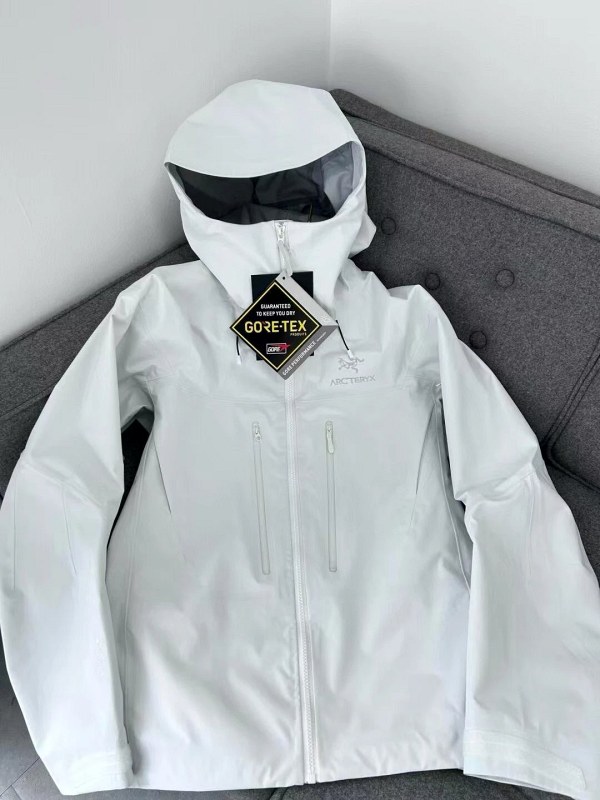
Our sample arrived in a plain poly bag, folded flat enough that we logged it on the unboxing bench before it had a chance to relax. The Arc'teryx White Waterproof Hard-Shell Jacket (SKU 7702033467) cost us $137.31 against a listed original of $154.90, and it is offered in S–XXL. The listing photo shows the details most people will judge it by: a full-length front zip, an attached hood over a high collar, two vertical chest pockets, and a small GORE-TEX tag riding on the zipper tape. The interior is dark, which is visible at the hood opening and makes a useful contrast when you are checking seams.
The seller's own listing line, translated from Chinese, reads: “SV7 polar white, Arc'teryx, in stock, ships immediately, S–XXL / casual snapshots, Uncle Bird.” That tells you the colourway name and the size run — it does not tell you fabric, membrane, weight, or condition. Everything below that is measured, we measured ourselves.
What we did to it before wearing it
We treat outerwear the way we treat a fixture: measure it cold, expose it, then measure again. Four passes over three days, at a bench temperature of 19 °C.
- Flat tape measurements. Our size M sample, laid flat and smoothed at the seams, measured 22 in across the chest, 27 in from collar base to hem, 25 in along the sleeve from shoulder seam, and 18.5 in across the shoulders.
- Seam and tape inspection under the loupe. Taped seams run continuously through the shoulders and hood. The only edge we flagged was at the left chest pocket, where the pocket zip termination meets the tape; it sits slightly proud rather than fully flat.
- Shower test. Five minutes under a shower head at roughly 30 cm, then ten minutes of light spray with the jacket on a hanger. Water beaded and shed from the hood and shoulders throughout. The sleeves were the first area to show wetting rather than beading, at around the eight-minute mark.
- White booth. We shot the shell in our white bay against a reference tile with fixed white balance, before and after the wet tests, to establish a baseline for the panel's whiteness.
Weight came in just under 400 g on our scale. Nothing about the construction felt flimsy: the main zip runs cleanly, the hood cinches without grabbing, and the collar stands high enough to sit against a chin without pushing on it.
Fit, layering and the sizing question
Our measurements land where Arc'teryx's own guide would put a medium, and the shell cut is roomy enough for a light mid-layer over a base layer without the shoulders pulling. That matches what long-term owners say: these shells generally run true to size, and many people size up specifically to fit insulation underneath. Arc'teryx's published guide is explicit about the between-sizes case — take the larger size for a looser fit, the smaller for a tighter one — and it notes that the men's fit was revised, with smaller sizes tighter and larger sizes looser.
Two things worth doing before you pick a size. First, ask the seller for flat measurements of the exact size you are buying; the listing gives S–XXL and nothing else. Second, if you plan to wear it over a mid-layer in cold weather, size up rather than trusting the "fits true" reports, which are written by people wearing a t-shirt underneath.
The GORE-TEX tag is branding, not documentation
We want to be exact here, because the tag on the front zip invites a bigger assumption than it earns. A visible GORE-TEX label on the zipper tape indicates the seller is presenting it as a membrane shell. It is not a substitute for the membrane specification, the fabric face weight, or the construction record, and none of those appear in the listing. We asked for fabric and membrane details and were not given them, so we cannot confirm which membrane generation or which face fabric this is. Treat “waterproof hard shell” as a claim to be verified, not a measured fact.
Polar white is the ongoing cost
This is the part of the review that matters more than the price. Owners of white and other bright Arc'teryx hardshells consistently flag visible yellowing and staining, and describe cleaning them as materially harder than darker colourways. One owner put it bluntly in a community thread: “It's a great choice if you're into yellowing, staining, and being unable to be rescued.” That is owner opinion, not a lab result, and our three-week baseline showed no measurable shift in the white booth — but three weeks in Portland spring is not three seasons of sunscreen, trail dust and car-seat grime.
If keeping a shell white is part of why you want it, plan for it: wash it more often than a dark shell, use a technical wash rather than detergent with softeners, and re-proof the DWR after cleaning. Dryer heat on low is part of reactivating the finish, not an optional step.
Durability: what the owner record says
Delamination stories exist in the Arc'teryx community and are worth reading before you commit — one owner describes a Beta AR that delaminated despite careful, frequent washing. Those reports are category-level and predate this listing; they are not a finding about this specific jacket, and we saw no delamination, bubbling or tape lift in our sample. What we can say is that the construction we could inspect is sound, and that our testing period is far too short to speak to a multi-season membrane lifespan.
What $137.31 buys, and what it does not
On the bench, the shell earns its money on the visible, checkable things: fit, seam coverage, beading, hardware and a clean white finish. It does not earn it on documentation. There is no stated condition record, no fabric or membrane specification and no measurement chart, so the purchase carries the ordinary risk of buying technical outerwear from a listing that describes appearance more thoroughly than construction.
That is why our score sits at 4 / 5 rather than higher. The jacket we handled behaves like a competent hardshell; the information around it does not yet support a stronger claim, and the colourway adds a maintenance bill that the price does not advertise.
Editor score 4.0 / 5
How we tested
Sources and notes
- Catalog product page
- Product listing verified on 2026-10-23.
Does the GORE-TEX tag on the zipper confirm the membrane?
No. It signals how the seller presents the jacket, not which membrane or fabric it uses. The listing states neither, and our request for those details went unanswered, so treat waterproofing as unverified until the seller documents it.
How much room is there for a mid-layer?
Our size M taped 22 in across the chest flat, which fits a base layer plus a light fleece. For anything thicker, or if you fall between sizes, follow Arc'teryx's guide and take the larger size.
How long did the water repellency last in testing?
Beading held on the hood and shoulders through five minutes of shower spray; the sleeves began wetting out around eight minutes into the spray pass. We re-proofed with a technical wash and low dryer heat afterward.