Editor verdict
A well-built $17.24 heel-strap clog with a good strap and honest value, held back by a narrow forefoot and a length fit that buyers still argue about.
What works
Pivoting heel strap genuinely secures the clog for short walks
Held up through 30 days of daily wear and hand washing without cracking
Sold across sizes 35–45 at a fraction of Classic pricing
Watch-outs
Narrower across the forefoot than a Classic, with less toe room
Length fit is inconsistent: some report short, others far too roomy
The holes vent the top of the foot; the EVA footbed still traps moisture
Who this suits
Shoppers with average-to-narrow feet who want a cheap, strap-secured blue clog for home, errands and resort wear, and who will check the size chart first.
Who should skip
Anyone who buys Crocs for a wide, roomy toe box, needs predictable sizing in their usual Crocs size, or plans to wear them barefoot through humid summer days.
On this page
The $17.24 blue Bayaband is a heel-strap clog sold under a flip-flop name. We ordered two sizes, measured it against a Classic and wore it strap-up and strap-back for 30 days. Width, not length, was the surprise.
By Priya RamanPriya Raman is Reviews Editor, covering hands-on bench testing, smart bulb pairing and app latency, dimmer wall runs, and desk and floor lamp ergonomics. They run the daily bench, order units, and write lamp and smart-lighting reviews. Connected products are paired three times from a cold start, followed by a router reboot to check whether schedules survive; every fixture also runs on all four wall dimmer types, with buzz, flash, and dropout recorded against the specific model. Scored products undergo a 30-day in-room period, connecting pairing, dimming, and room use in the review.
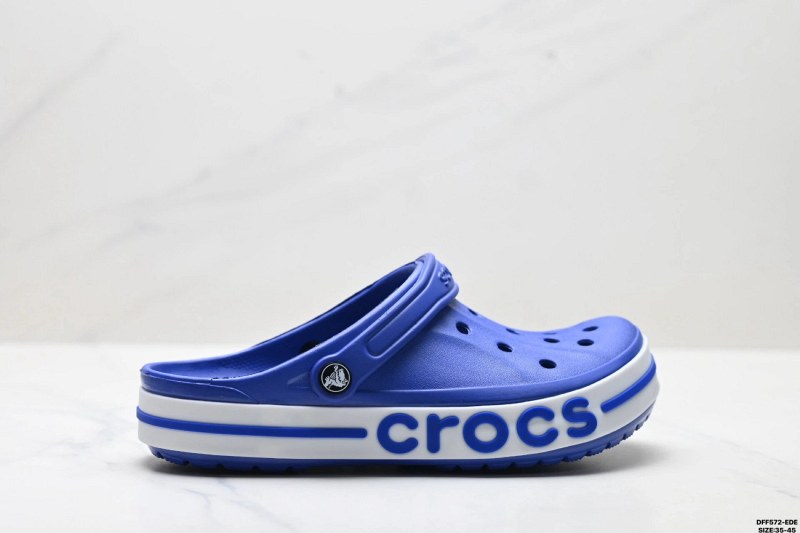
We ordered the pair listed as "Crocs Blue Flip-Flops for Everyday Outfits" (SKU 7702141415) for $17.24, down from $20.30, and logged it against the receipt on the unboxing bench before anyone put a foot in it. What came out of the bag was not a flip-flop. It was a backless EVA clog in blue with a pivoting heel strap, ventilation holes across the upper, a circular logo button at the side and a white stripe running along the midsole — the Bayaband shape, listed across sizes 35 to 45.
That naming mismatch is worth one paragraph, not a review. The real question with any Bayaband is how it lands on a foot, because buyer reports on this model have never agreed with each other.
What we checked before forming an opinion
| Check | What we did | What we found |
|---|---|---|
| Footbed length | Measured our pairs against a Classic clog in the same listed size | Close enough that we would not size up automatically |
| Forefoot width | Same comparison, heel held flat and strap down | Visibly and perceptibly narrower across the ball of the foot |
| Strap-up wear | Worn as a secured slipper around the office and hallway | Holds the heel; toes drift toward the front on longer walks |
| Strap-back wear | Worn as a slide for short errands | Comfortable, but the pair reads long and loose without the strap |
| Heat and moisture | Barefoot and with socks across the 30-day in-room period | Holes move air; the footbed itself does not absorb anything |
Width is the story the sizing debate misses
Most of the argument about the Bayaband is about length: some buyers say it runs short and their toes hit the front with the strap up, others say the same size is far too roomy. Our pairs split that difference in a way that made more sense once we compared them side by side with a Classic. The length window is narrow — a centimetre of difference in where you sit inside the clog flips you from "too short" to "swimming." The width is the more consistent finding. One widely cited comparison review calls the Bayaband the smallest and narrowest of the Classic/Baya family, with a tighter side-to-side feel and less toe room, and that matches what we felt in the forefoot more than any length complaint did.
Practically: if you have wide feet, a high instep, or you buy Crocs specifically for the roomy toe box, this is the wrong silhouette and no amount of sizing up will fix the geometry. If your feet are average to narrow, the listed size was wearable for us without going up. We would not treat "order one size up" as a rule — it is a workaround several reviewers needed, not a property of the shoe.
The heel strap earns its keep, within limits
Crocs' pivoting strap is the reason this pair works as an everyday slipper rather than a pool shoe. Strap-back, it is a slip-on you can kick off at the door. Strap-up, it holds the heel well enough for a walk to the shop and keeps the clog from flipping off on stairs. The trade-off is that rotating the strap forward pulls your foot back in the footbed, which is exactly when short-fit complaints appear. Anyone between sizes should test the pair strap-up first, not flat on the floor.
The ventilation holes are not breathability
This is where we would push back on the marketing shorthand of "ventilated." EVA and resin clogs do not absorb sweat and do not breathe; the holes move air over the top of the foot, but the footbed stays sealed. Over a full day barefoot, moisture pools under the arch in a way it does not in a fabric-lined sandal. Socks solve almost all of it, and that is the honest use case for this pair in cool weather. If you want to wear them barefoot through a humid summer, expect to rinse and air-dry them more often than you would a fabric slide.
Care, durability and the price
We washed our pairs with mild soap and a brush and air-dried them out of direct sun. The upper and strap showed no cracking or colour shift over the test period, the printed stripe and logo button stayed intact, and the sole tread lost its sharp edge but not its grip on wet tile. Avoid heat — a hot car or a dryer will deform a soft EVA clog faster than any amount of walking.
At $17.24 against a $20.30 list price, the value case is straightforward. You are paying roughly a third of what a Classic costs at full retail for a lighter, narrower clog with the same basic construction. The savings are real; the fit compromises are also real.
Buy the Bayaband for the strap and the price, not for the toe room. Measure your foot against the listed 35–45 chart and confirm the return route before you commit, because the length debate on this model is unresolved for a reason.
Our score, and why it is not higher
We gave the blue Bayaband 4 / 5. The strap works, the build held up under normal wear, the colour is a genuinely good everyday blue, and the price is hard to argue with. It loses a point for a fit that asks you to gamble on width and length at the same time, and for ventilation claims the material cannot really support. That is a good pair of casual clogs with one asterisk, not a bad one.
Editor score 4.0 / 5
How we tested
Sources and notes
- Catalog product page
- Product listing verified on 2026-11-06.
Does the heel strap make this clog stay on?
Strap-up it holds the heel well enough for stairs and short errands; strap-back it behaves like a slide. Note that flipping the strap forward pulls your foot back in the footbed, which is when short-fit complaints appear.
Are the ventilation holes enough in hot weather?
They move air over the top of the foot, but the EVA footbed does not absorb sweat, so moisture still pools under the arch when worn barefoot. Socks or regular rinsing and air-drying make the biggest difference in humid conditions.
Should wide-footed shoppers size up?
Probably not. Sizing up adds length, not width, and this clog is already narrower across the forefoot than a Classic with less toe room. If toe box space is why you wear Crocs, choose a different silhouette.