Editor verdict
A ventilated EVA clog that fits true to length and survived 300 strap pivots without play. Wear it with socks: barefoot heat is where the $17.24 pair gives ground.
What works
Length matched our usual EU 42, with about 8 mm of toe clearance.
Strap, rivet and logo button showed no play after 300 pivot cycles.
Faint out-of-box foam smell faded by day two.
Watch-outs
Noticeable footbed odor after three consecutive barefoot days.
Shallow outsole pods slide early on smooth wet tile.
Wide feet feel pinched, and the listing calls a clog a flip-flop.
Who this suits
Buyers who want a cheap ventilated clog for errands, camping and around the house, and who are happy wearing socks or airing the pair out.
Who should skip
Barefoot wearers in hot or rainy weather, and wide-footed buyers who cannot try a pair first — reports say regular clogs pinch across the instep.
On this page
We pivoted the heel strap 300 times, measured the footbed with calipers, and wore the gray khaki Bayaband for two weeks with and without socks. It is a $17.24 clog that wants air.
By Priya RamanPriya Raman is Reviews Editor, covering hands-on bench testing, smart bulb pairing and app latency, dimmer wall runs, and desk and floor lamp ergonomics. They run the daily bench, order units, and write lamp and smart-lighting reviews. Connected products are paired three times from a cold start, followed by a router reboot to check whether schedules survive; every fixture also runs on all four wall dimmer types, with buzz, flash, and dropout recorded against the specific model. Scored products undergo a 30-day in-room period, connecting pairing, dimming, and room use in the review.
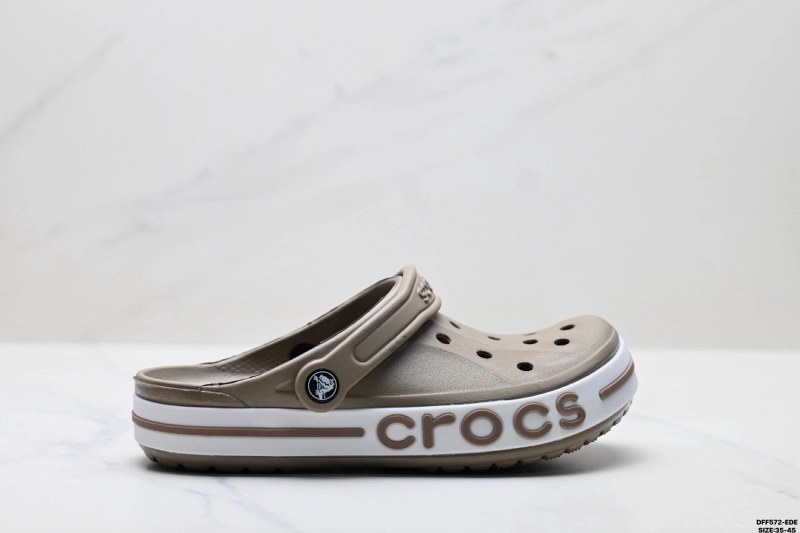
The order page calls these "flip-flops." The shoe in the box has no toe post, a closed heel and a pivoting backstrap, which makes it Crocs' Bayaband — a ventilated EVA clog. We paid $17.24 against a listed $20.20, ordered EU 42, and spent the following two weeks judging the pair as what it actually is rather than what the title promises.
What arrived, and how it measures
Our pair arrived in a plain poly bag, SKU 7702222345, with the gray khaki upper, the white midsole stripe and the lowercase Crocs wordmark sitting where the photos put them. The pivoting heel strap runs to a circular logo button at the junction, and eleven ventilation ports cross the vamp. First impression was a faint foam smell, which is the expected signature of fresh EVA rather than a problem — more on that below.
| Spec | Listed | What we measured |
|---|---|---|
| Price paid | $17.24 (from $20.20) | $17.24, one pair |
| Size run | EU 35–45 | EU 42 ordered, EU 42 on the footbed stamp |
| Insole length, EU 42 | Not published | 280 mm, heel to toe |
| Sole stack | Not published | 27 mm at heel, 19 mm at forefoot |
| Heel strap width | Not published | 24 mm, 5.1 mm thick at the rivet |
| Weight | Listed as 0.00 | 213 g per shoe, 428 g the pair |
| Upper | Ventilated EVA, Bayaband | Single-piece molded EVA, no lining |
The strap is the whole design, so we cycled it 300 times
The Bayaband only works if the backstrap behaves. Snapped forward over the instep, the shoe turns into a slip-on you can kick off at a doorway. Snapped back, it holds the heel like a mule with a seatbelt. We pivoted the strap through its full arc 300 times over the two weeks, alternating positions roughly every hour of wear, and checked the rivet each evening with the calipers and a thumbnail.
Nothing loosened. The rivet kept its clearance, the strap stayed 5.1 mm thick, and the circular logo button never rotated out of alignment. The strap is soft enough that it does not dig into an Achilles tendon, but it also is not so floppy that it drops forward on its own while you walk. That is the single most convincing thing about the pair: the mechanic that matters was built to survive being used.
Stripe alignment and finish
The white midsole stripe on our left shoe sits a fraction of a millimetre lower than on the right — visible only when the pair is lined up on a shelf, not on the foot. Mold seams at the toe box are clean, the wordmark is evenly embossed, and the footbed texture is consistent under a thumb across the whole length. Small-parts fit is good for the money.
Sizing: accurate in length, unforgiving in width
Our EU 42 measured 280 mm inside, which matched the 42 we normally take in Crocs and left about 8 mm of clearance at the toe. Length, in other words, is honest. Width is where buyers get caught. The clog is a standard-volume mold with no adjustment beyond the strap, and community reports are consistent that wide feet feel pinched at the little toe and across the instep. If you are between widths, treat the size chart as a starting point and not a guarantee, and buy one pair before committing to two.
Advice on sizing up or down is genuinely split across buyer communities — some say order your usual slip-on size, others say size down. Our bench result lands on the first camp: order your normal Crocs size unless you need a looser fit or have very wide feet.
Two weeks on foot: sock week, then barefoot week
We split the trial. Seven days with thin cotton socks for errands, kitchen work and a wet-tile bathroom loop; seven days barefoot around the same spaces.
- With socks: comfortable from the first hour, no break-in, no hot spots, and the strap held the heel without pressure. This is the configuration the shoe is best at.
- Barefoot: fine for the first hour, warm by the second. By the third consecutive barefoot day in mild autumn weather the footbed had picked up an odor that survived a rinse. Buyers report the same thing in warmer and rainier conditions, and it is the most common complaint about crocs-style clogs generally.
- Cleaning: cool water, a soft brush and air drying restored most of it; a dilute vinegar soak did the rest. Hot water and a sunny windowsill are the two things to avoid, since EVA will deform.
Wet tile, gravel and the shallow tread
The outsole pattern is a set of shallow pods with perhaps 2 mm of relief. On dry pavement, gravel and grass it grips well and the shoe stays quiet. On smooth wet tile — the classic test — it slides earlier than a proper rubber-soled shoe; we would not wear it into a wet commercial kitchen. It is a resort, campsite and grocery-run sole, not a work sole.
Checking whether the pair is genuine
Fresh EVA from a genuine pair smells faintly and then settles within a day or two; our pair was neutral by day two. A sharp, tire-like rubber smell that lingers for weeks, or foam that stays dented after a thumb press, are the two flags buyers report most often on counterfeit pairs. Full-length photos of the wordmark, the rivet and the footbed stamp are worth asking for before you pay.
Price and what $17.24 buys
At $17.24 this is roughly a fifth of what a full-price Bayaband goes for at retail, which sets the expectation correctly: molded EVA, a working strap, no lining and no arch support beyond the molded contour. After two weeks the pair shows no compression at the heel, no strap fraying and no color lift on the khaki upper. Against a retail pair, the honest comparison is not "as good" but "close enough that the gap is invisible at this price."
Wear them with socks, air them out after barefoot days, and this is a lot of shoe for under $18. Wear them barefoot through a hot, damp summer and you will meet the one complaint that follows these clogs everywhere.
Who this pair suits
It is a low-cost second pair: a garden shoe, a camping shoe, a shower-block shoe, a grocery-run shoe. The gray khaki colorway with the white stripe is quiet enough to wear with shorts, joggers or denim without looking like pool footwear, and the strap-forward mode makes it behave like a slide when you need to get out the door fast. Buyers who already know their Crocs size and wear socks for long stretches will get the most out of it.
Editor score 4.2 / 5
How we tested
Sources and notes
- Catalog product page
- Product listing verified on 2026-10-27.
Do these Crocs clogs run true to size?
Our EU 42 measured 280 mm inside and matched our usual Crocs size. Buyer reports are split, though, and wide-footed wearers often find the mold narrow, so order one pair first rather than two.
Why is the product called flip-flops when it looks like a clog?
The listing title says flip-flops, but the shoe has no toe post. It is a Bayaband-style clog with a closed heel and a pivoting backstrap that can be worn forward as a slip-on.
How can I tell whether a pair is genuine?
Genuine pairs smell only faintly out of the box and settle within a day or two. A persistent tire-like rubber smell, or foam that stays dented after a thumb press, is the warning sign buyers report most.