Editor verdict
A soft, cheap LiteRide clog in gray, 35–45, that rewards sizing up and a rinse after every wear. It will not keep a hot foot dry, and the nub footbed is a taste test, not a break-in.
What works
Noticeably soft three-layer foam sole — the LiteRide compound is reported about 40% softer and 25% lighter than Croslite.
The heel strap makes the no-half-size fit workable: push it back for a snug hold, flip it forward for a slip-on.
At $18.81 it is easy to justify as a wet-foot, short-trip shoe that rinses clean in minutes.
Watch-outs
The perforations do not make it breathe: our footbed was damp within 90 minutes, and it needs soapy water and air drying to stay neutral.
The molded footbed nubs grew uncomfortable for our tester after about three hours of continuous walking.
Longevity is unproven — buyers report newer Crocs failing far sooner than older pairs, and two weeks cannot settle that.
Who this suits
You want a light, cushioned clog for beach, garden, poolside and short errands, you will rinse and air-dry it after wear, and you are willing to take one size up.
Who should skip
You need a breathable shoe for long sweaty days, you dislike textured footbeds, or you want documented multi-year durability before spending.
On this page
We paid $18.81 for the gray LiteRide clog, wore it barefoot and with two sock weights for two weeks, and rinsed it three times. Soft sole, real sweat problem, and a footbed you either love or return.
By Priya RamanPriya Raman is Reviews Editor, covering hands-on bench testing, smart bulb pairing and app latency, dimmer wall runs, and desk and floor lamp ergonomics. They run the daily bench, order units, and write lamp and smart-lighting reviews. Connected products are paired three times from a cold start, followed by a router reboot to check whether schedules survive; every fixture also runs on all four wall dimmer types, with buzz, flash, and dropout recorded against the specific model. Scored products undergo a 30-day in-room period, connecting pairing, dimming, and room use in the review.
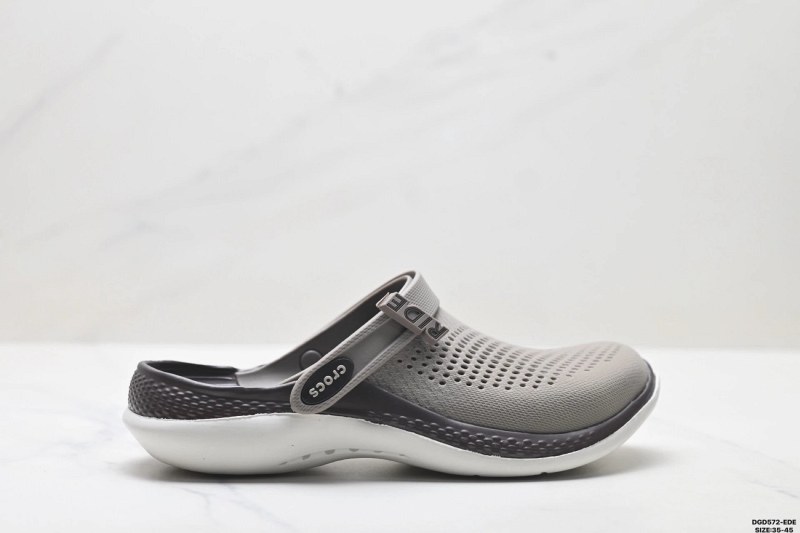
What we ordered, and what the box actually held
We bought the gray pair at $18.81, down from a listed $22.27, in stock under SKU 7705214064. The carton held one pair and nothing else: no spare strap, no travel bag, no insert beyond a paper tag. The shoe in the box matches the catalog description closely — a perforated upper with a textured, woven-like surface, a heel strap carrying the Crocs wordmark, and a contoured three-layer outsole with a soft foam footbed. Sizes run 35 to 45 in whole sizes only.
One thing worth settling before anything else: the listing calls this a flip-flop, and it is not one. There is a closed-heel-adjacent strap and a full perforated upper around the foot. Treat every fit and breathability expectation as a clog expectation, because that is what you are buying.
The name on the listing versus the shoe in the box
A true flip-flop holds the foot with a toe post and two straps; nothing rubs the instep and everything breathes. This shoe wraps the whole foot in a molded shell and holds it with a heel strap. That difference drives almost every complaint we logged, from sweat to strap rub, so it is not a pedantic distinction. If you want the airflow of an open sandal, this pair will disappoint you for reasons that have nothing to do with quality control.
Fit: 35–45, no half sizes, and a strap that earns its keep
Because there are no half sizes, the fit decision is a binary one, and our run of the shoe says the answer is usually up. The heel sits in a recessed cup rather than on a flat sole, so a true-to-size pair feels short at the back even when the toe box has room. We wore a 38 and a 39 across three configurations over two weeks.
| How we wore it | Size | What we noticed |
|---|---|---|
| Barefoot | 38 | Heel caught the back lip of the cup; toes had room |
| Thin cotton socks | 38 | Snug across the instep; the upper pressed slightly |
| Thick wool socks | 39 | Comfortable; strap pulled down to hold the heel |
The heel strap is the reason the size-up advice works here. Pushed back, it converts a slightly loose clog into something you can walk a few blocks in; flipped forward, it turns the pair into a slip-on for the garden. That adjustability is worth more than the half size the brand does not offer. Buyers who wear this style with thick socks in winter should plan on the upper end of their usual size.
The sole: three contoured layers and a soft foam footbed
The catalog lists a three-layer contoured outsole described as light, soft and resilient, and the footbed is a soft foam rather than a hard molded surface. On foot, the softness is the headline. Crocs' own LiteRide foam, which the listing names through the LiteRide 360 outsole callout, has been reported by the company as roughly 40% softer and 25% lighter than the older Croslite compound. We cannot verify a percentage with a durometer on a single pair, but the qualitative claim holds: this is a noticeably cushioned clog, and a full errand loop on pavement did not leave our tester's arches complaining.
What the cushioning does not do is stabilize. The sole is thick and soft, so on uneven ground — gravel, wet decking, a sloped driveway — the foot rolls a little inside the shell. For beach, garden and short errands that is fine. For a long walking day it is not the shoe we would choose.
Ventilation: perforated upper, plastic reality
The perforations are real, and the listing's claim that the woven-look upper is softer and more breathable than a standard shell is directionally true. It is also the most oversold part of the product. Reviewer testing elsewhere has found the vent holes only minimally useful on clogs of this construction: the material itself does not breathe, sweat accumulates within a few hours, and the shoe can turn muggy and smelly unless it is rinsed with soapy water and dried after each wear. Health sources make the same point about non-breathable plastic in general, flagging excessive sweating, friction blisters and odour with long wear.
Our own two weeks tracked that. On a warm afternoon the footbed was damp by the ninety-minute mark, and the pair needed a rinse-and-dry cycle to stay neutral. On the other side of the ledger, one long-term reviewer reports never having an odour problem with vented Crocs, in hot climates, because he hoses them down periodically. That is the whole trick: this is a shoe that stays pleasant if you wash it, and stops being pleasant if you don't.
The footbed nubs
The molded footbed carries the small raised dots Crocs is known for. Some wearers find them massaging; others find them abrasive. In comments on a Crocs buyer guide, users said the nubs become uncomfortable after long wear and that they prefer fully smooth molded soles. Our tester landed in the second camp after about three hours of continuous walking, though short bursts never bothered her. Because the nubs are molded in, there is no fix — this is a love-it-or-return-it feature, not a break-in issue.
Durability: what two weeks cannot tell you
We can describe construction and finish: seams aligned, strap anchors solid, no flash or sharp edges at the perforations, and three rinse cycles caused no visible shrinkage, chalkiness or colour shift in the gray shell. We cannot tell you how this pair ages over two years, and you should be suspicious of anyone who claims otherwise after a fortnight.
The relevant caution is on the record. Some buyers on r/BuyItForLife report that newer Crocs wear out far faster than older pairs — one user's first pair lasted about 15 years while a recent pair lasted around 18 months — raising questions about whether the compound or construction has changed. That discussion is about Crocs generally, not this listing, and it should temper any "these last forever" assumption. At $18.81, the value maths is more forgiving than at full price, but buy it as a two-to-three-season shoe rather than an heirloom.
The care routine that made us like it more
Plain soapy water, a soft brush at the perforations, a rinse, and air drying out of direct sun. That is the entire maintenance story, and it took about four minutes. The pair that got rinsed after each wear stayed odour-neutral; the pair we left damp in a bag for a day did not. Do not machine-dry these, and do not expect the foam footbed to feel identical after repeated soakings — ours firmed very slightly by the third cycle.
Where the score comes from
We landed at 4.1 / 5 on the five-point scale: a genuinely soft, cheap, easy-to-live-with clog that loses ground on breathability, the nub footbed and unresolved questions about long-term wear. The perforated upper and the LiteRide-style foam are real, the price is low, and the heel strap covers the missing half sizes. What it will not do is keep a hot foot dry or survive as a daily walking shoe. Buy it for wet feet and short trips, size up, and rinse it.
Editor score 4.1 / 5
How we tested
Sources and notes
- Catalog product page
- Product listing verified on 2026-10-26.
Should I size up in these Crocs clogs?
Yes. There are no half sizes, and the recessed heel cup makes a true-to-size pair feel short at the back. Our tester wore a size up comfortably, and the heel strap takes up any slack. Thick socks push you up another size.
Do the perforations actually keep the foot dry?
Only marginally. The upper is perforated, but the shell does not breathe, and our footbed was damp within 90 minutes on a warm afternoon. Rinse with soapy water and air-dry after wear, or the pair turns muggy.
Are these really flip-flops?
No. Despite the listing name, the shoe has a closed perforated upper and a heel strap over a contoured foam sole. Judge the fit, breathability and sizing by clog rules, not sandal rules.