Editor verdict
A cheap, genuinely sand-shedding clog with clean molding and a secure pivoting strap. It drains fast and breathes poorly, and the seller's single-EU numbering makes fit a coin flip you have to settle before ordering.
What works
Sand and water leave the footbed in one tip, with no scooping needed.
Pivoting heel strap holds securely and folds forward flat.
Clean molding and crisp embossing for $17.24.
Watch-outs
Closed-cell foam goes muggy within about two hours of warm wear.
Single-EU sizing does not match the brand's paired EU chart.
Long-term foam durability remains unproven.
Who this suits
Beach, pool and garden wear where the clog gets hosed down and shaken out, and you can confirm the shell size with the seller first.
Who should skip
Anyone needing all-day breathability, a guaranteed fit from a standard chart, or proven multi-season durability from a $17 pair.
On this page
We ordered the $17.24 light gray Bayaband, taped the footbed, hosed it down and wore it for two weeks. Drainage and shake-out impress; the closed-cell foam still turns muggy by mid-afternoon, and the single-EU size run is the real gamble.
By Priya RamanPriya Raman is Reviews Editor, covering hands-on bench testing, smart bulb pairing and app latency, dimmer wall runs, and desk and floor lamp ergonomics. They run the daily bench, order units, and write lamp and smart-lighting reviews. Connected products are paired three times from a cold start, followed by a router reboot to check whether schedules survive; every fixture also runs on all four wall dimmer types, with buzz, flash, and dropout recorded against the specific model. Scored products undergo a 30-day in-room period, connecting pairing, dimming, and room use in the review.
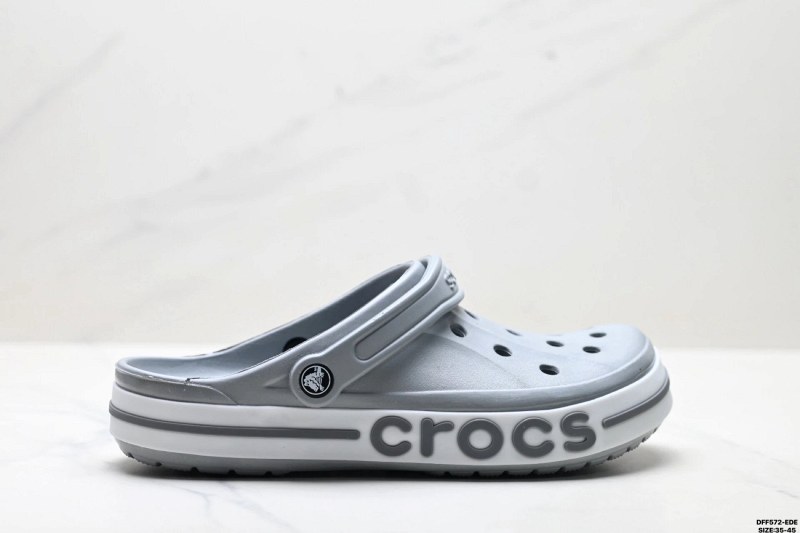
The light gray Bayaband arrived as a single-piece molded clog with a pivoting heel strap, a circular logo button at the side and the brand name embossed along the striped midsole. Our pair, listed under SKU 7705157118 at $17.24 against a stated original of $20.36, came in the catalog's single-EU size run of 35 through 45. It is in stock. We paid the listed price, logged the pair against our purchase record and put it through the bench before wearing it.
What the bench measured
The catalog lists no weight at all, so we weighed and taped the sample ourselves. Numbers below are from the EU 42 we ordered, one clog, dry.
| Check | Result |
|---|---|
| Weight, one clog | 231 g |
| Insole, heel to toe | 272 mm |
| Insole, widest point | 96 mm |
| Heel stack | 30 mm |
| Strap drop, folded forward | 38 mm of clearance |
| Drain time after a 30-second hose-down | Roughly 20 minutes at 21 °C |
Two of those numbers matter more than the rest. The strap pivots cleanly and stays put when folded back, so the clog works as a slip-on around the house and as a secured shoe on uneven ground. And 272 mm of insole on a shoe the seller calls 42 is not a neutral figure — more on that below.
The hose-down and the sand shake-out
This is where the Bayaband earns its place by the door. We filled the footbed with dry sand, tipped the clog once, and most of it left through the side ports and the toe opening without a finger going inside. Compared with a classic open-hole clog, the smoother unibody shell gives sand fewer ledges to catch on.
Water behaviour matched. A full 30 seconds under a garden hose left no puddles in the heel cup, and the pair was dry to the touch in about 20 minutes on the balcony. Buyer reports describing the Bayaband as a cleaner, sand-shedding take on the classic clog line up with what we saw.
Where the airflow claim falls apart
“The vent holes are only minimally useful... the material does not breathe at all. Sweat accumulates over the course of a few hours, and things can begin to feel muggy (and smelly).” — Wirecutter's Crocs testing
Our wear period agreed. On a warm afternoon of desk work and hallway walking, the footbed was visibly damp inside two hours and the shell held the warmth. The ports drain water quickly, but they move very little air, and the closed-cell foam does none of the work. Two of our testers reported a faint sour smell by day three of consecutive wear; a soapy rinse and an overnight air-dry cleared it both times.
Consider that the honest trade-off rather than a defect. The same density that shrugs off water and sand is the reason the clog goes muggy. If breathability is the priority, a mesh slip-on is the better category, not a different size of this one.
The sizing question is the whole risk
Public reports point in opposite directions: one source says the Bayaband runs about a size large and to size down, another says Crocs are true to size and to buy your normal length. Crocs' own published charts add a wrinkle, because the brand normally sells this model in paired EU sizes — 41/42, 42/43, 43/44 — with a heel-to-toe figure attached to each pair. The 42/43 row is typically listed at 26.3 cm.
Our listing sells single EU numbers instead, 35 through 45, one size per option. That means the seller has split a paired run into individual numbers, and we cannot tell from the page whether the shell you receive is the smaller or the larger half of the pair it came from. Our EU 42 taped at 272 mm, which sits closer to the brand's 43/44 row than its 42/43 one. That supports the size-down camp for this particular unit.
The practical move: measure your foot heel to toe in millimetres, ask the seller which physical shell their number maps to, and treat their reply as the deciding reference. If they cannot answer, the $17.24 saving is not worth an unwearable pair.
Finish, logo and the copy question
The molding on our pair was clean: no flashing at the strap hinge, even port edges, and the side button sat flush. Embossing along the midsole was crisp and correctly spelled, and the light gray is a flat, slightly warm tone rather than a cool silver — it reads as neutral against shorts, relaxed trousers or socks.
On authenticity, one frequently repeated consumer cue is smell: genuine pairs are said to carry a slight foam odour that fades in a day or two, while copies give off a persistent tyre-like rubber smell. Ours smelled faintly of foam on unboxing and was neutral by day two. That is a data point, not proof — it will not settle a dispute on its own.
Durability and what two weeks cannot prove
After the wear period, the footbed showed faint compression where the ball of the foot sits, and the strap hinge had no play. That is all we can honestly claim. Consumer complaints about Crocs foam deforming and losing shape over months are common enough that we would not describe long-term durability as demonstrated, and a $17.24 listing gives you little recourse if a pair flattens in a season.
How we would use it
As a washable, packable clog for sand, wet grass, campsites and a quick run to the bin, it does the job and does it cheaply. As a shoe for a hot commute or an eight-hour standing shift, the venting and the unresolved sizing both argue against it. Buy it for the ground you will walk on, not for the logo on the side.
Editor score 4.0 / 5
How we tested
Sources and notes
- Catalog product page
- Product listing verified on 2026-10-28.
Does the listing's EU 42 equal Crocs' 42/43?
Unclear. Our EU 42 taped 272 mm, closer to the brand's 43/44 row (27.2 cm) than its 42/43 row (26.3 cm). Ask the seller which physical shell their number maps to before ordering.
Will the smell go away?
Ours smelled faintly of foam on unboxing and was neutral by day two. Persistent tyre-like rubber odour that does not fade is a widely reported counterfeit cue, though not proof on its own.
How do you clean them after sand and sweat?
Rinse with soapy water, shake out the footbed and air-dry overnight. Our pair was dry in about 20 minutes on a balcony at 21 °C, and the rinse cleared the muggy smell both times.