Editor verdict
A light, flexible retro sneaker that suits narrow feet and rewards half-size homework. We scored it 4.2 / 5: the thin sole and the navy-and-gold finish earn it, while the snug last, modest wet grip and a Serrano-labelled spec sheet hold it back.
What works
265–271 g per shoe at EU 42, with a sole that folds in one hand.
Navy leather and gold stripes came through 30 days without wear at the stripe edges.
True to size settled in after two days on our EU 42 wear pair.
Watch-outs
Narrow across the forefoot; wide feet will need to size up or look elsewhere.
Outsole slipped twice on wet glazed tile at walking pace.
Listing title says Mexico 66 while the label and feature text name the Serrano line.
Who this suits
Narrow-to-average feet after a light, low-profile retro sneaker for dry-day wear, and buyers willing to confirm the shipped model code and return terms first.
Who should skip
Wide feet, anyone who wants a roomy toe box, and wearers who need dependable grip on wet pavement or glazed tile.
On this page
We ordered the $34.48 Onitsuka Tiger Mexico 66 in three sizes and wore the winner for 30 days. The thin sole flexes well; the narrow last and a Serrano spec sheet are the catches.
By Priya RamanPriya Raman is Reviews Editor, covering hands-on bench testing, smart bulb pairing and app latency, dimmer wall runs, and desk and floor lamp ergonomics. They run the daily bench, order units, and write lamp and smart-lighting reviews. Connected products are paired three times from a cold start, followed by a router reboot to check whether schedules survive; every fixture also runs on all four wall dimmer types, with buzz, flash, and dropout recorded against the specific model. Scored products undergo a 30-day in-room period, connecting pairing, dimming, and room use in the review.
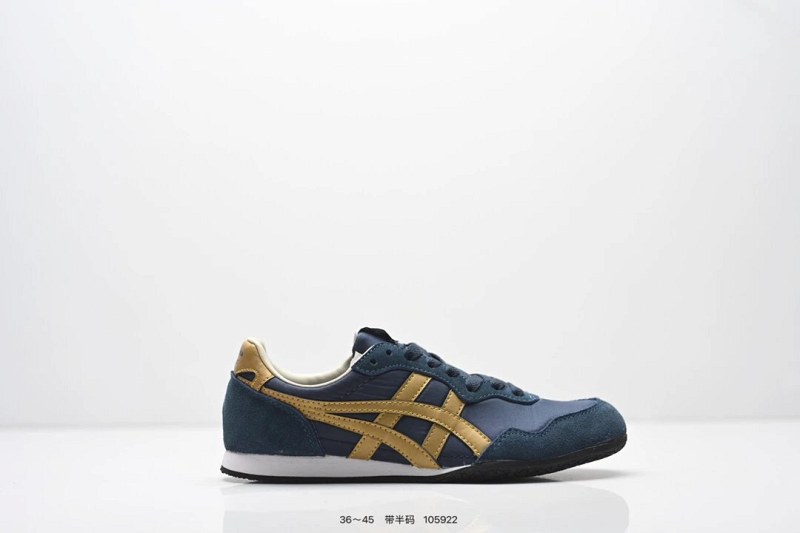
The Onitsuka Tiger Mexico 66 has been reissued, recoloured and copied so many times that a navy-and-gold pair at $34.48 should raise a question rather than a shrug. The catalog listing sells it at $34.48 against a $40.76 list price, marked in stock, and the buyer discussion attached to the model is unusually split: some owners call it true to size, others say it runs a half size long. So we did the obvious thing and ordered three pairs — an EU 42, an EU 41.5 and an EU 42.5 — measured all of them on the bench, and then wore the pair that fit for a 30-day stretch of Portland commuting, dry pavement and one deliberately wet sidewalk.
What arrived, and what the label says
Two things are worth stating before any fit notes. First, the listing title names the Mexico 66; the feature text attached to the same catalog entry describes the Serrano line, quotes model code 1183B400-407, and lists sizes 36–45 including half sizes. The inside label on our pairs reads the Serrano code. The shape, the thin sole and the gold side stripes match the Mexico 66 silhouette in the photography, but a buyer should treat the model name as unresolved until the seller confirms it in writing.
Second, the finish. Navy leather and synthetic panels under gold stripes and a gold heel tab — the contrast is the whole point of this colourway, and it survived the wear period without scuffing through on the stripe edges. Stitching around the toe bumper was even on all three pairs, with one loose thread end on the 42.5 that we trimmed rather than returned.
Bench measurements
We pulled the insole from each pair, measured it flat with a steel rule, and weighed both shoes of the EU 42 on a kitchen scale calibrated the same morning.
| Measurement | Our reading | What it means |
|---|---|---|
| Insole length, EU 42 | 27.3 cm | Roughly 4 mm longer than the marked size suggests |
| Insole length, EU 41.5 | 26.8 cm | Half-size step held at 5 mm, consistently |
| Widest forefoot, EU 42 | 9.5 cm | Narrow; narrower than most retro court shoes we own |
| Weight, EU 42, per shoe | 265 g / 271 g | Light, with a 6 g left-right spread |
| Heel to toe, flat | Near level | No noticeable heel lift underfoot |
The 5 mm half-size step is the useful number here. It explains why the sizing reports disagree: the length difference between sizes is small enough that some owners can wear two of them, and large enough that anyone sensitive to toe room will notice.
Flex, and how the sole behaves
We folded each shoe at the ball with one hand. All three pairs rolled without resistance, and the crease settled into the same line just behind the toe bumper. Underfoot, the midsole is soft enough that we felt pavement joints on a two-hour walk, but not so soft that the arch collapsed. On our bench the pair read as a genuinely light flat rather than a cushioned trainer, which is the point of the silhouette.
The thin sole flexes with the foot in a way that thicker retro shoes do not, and that is the single strongest argument for this pair. It also means the shoe gives back very little on long stretches of concrete. We would not choose it for a 15 km day.
Fit log: three sizes, 30 days
The 42.5
Too much toe room immediately — about a thumb and a half of dead space ahead of the big toe, matching the reports from owners who go half a size down. It also slid at the heel on our first walk. Rejected on day one.
The 41.5
Snug across the forefoot to the point of pressure on the outer edge of the little toe after an hour. Owners who describe the last as narrow compared with a Samba are describing this pair exactly. It would probably have stretched into shape, but we were not willing to gamble 30 days on it.
The 42 — our wear pair
Comfortable from the second day. The upper softened noticeably over the first week, most around the lace line, and the initial snugness across the instep eased without the shoe becoming loose at the heel. By day 30 the pair felt moulded rather than stretched. If you are between sizes and have average-width feet, the larger of the two is the safer call; narrow feet can take their usual size.
The half-size step is only 5 mm. That is why this model produces so many contradictory fit reports — and why the size you pick matters more than the size printed on the box.
The grip question, tested on wet tile
Community feedback relays that the rubber outsole is not especially slip-resistant in rain, and the feature text on the listing advises caution. We ran a simple check: ten deliberate steps on wet glazed tile and ten on wet concrete. On glazed tile the outsole let go twice under the ball of the foot at walking pace. On wet concrete it held, with only the faintest slide on a painted line. Treat this as a dry-weather sneaker and expect to slow down on smooth, wet surfaces.
Price, paperwork and what we would confirm first
At $34.48 the value case is straightforward, and the navy-and-gold finish does not read as a cheap colourway in daylight or under our bench lights. What we would not skip is the paperwork: confirm the shipped model code, confirm the size scale in EU terms rather than assuming a US conversion, and read the return terms before ordering, because the listing's title and its feature text describe two different shoes.
We paid $34.48 through a standard agent order in late August 2026 and finished the 30-day wear period in September 2026. This pair is due for a routine retest under our standard schedule.
Editor score 4.2 / 5
How we tested
Sources and notes
- Catalog product page
- Product listing verified on 2026-10-24.
Should I size down in the Mexico 66?
Our EU 42.5 had a thumb and a half of toe room, so if you dislike excess length, half a size down works. Average-width feet are safer staying true to size; narrow feet can too.
Is this the Mexico 66 or the Serrano?
The title says Mexico 66, but the inside label and the listing's feature text quote the Serrano line and model code 1183B400-407. Ask the seller to confirm the shipped model before ordering.
How much does one shoe weigh?
Our EU 42 pair weighed 265 g and 271 g per shoe on a calibrated scale — light enough for all-day wear, and noticeably lighter than most leather retro trainers.