Editor verdict
An $8.36 combed-cotton tee that measured close to Rhude's published M row, with a print that survived five washes and a shoulder plate that matters more than the stated tolerance.
What works
Print held through five warm wash-and-dry cycles with no flaking or cracking
Flat measurements landed inside the stated 1–3 cm tolerance on all three points
Mid-length sleeve and loose body read as the streetwear cut the listing describes
Watch-outs
The 1–3 cm tolerance is as wide as the chest gap between M and L, so one size can read as the next
Shoulder stays flat from M to L while the chest keeps growing, so the shoulder governs the fit
Fabric weight is quoted as a 180–250 g range, not a single figure, and we could not weigh it
Who this suits
You want a loose, mid-length-sleeve summer tee with a lettering print, and you will compare the listing's shoulder number against a shirt you already own.
Who should skip
You want a standard true-to-size body or a trim fit, or you would rather not measure your shoulder before ordering a boxy cut.
On this page
We ordered RH236 in black and RH233 in apricot at $8.36 each, measured them flat, washed them five times and shot them under two colour temperatures. The shoulder line, not the chest, decides the size.
By Priya RamanPriya Raman is Reviews Editor, covering hands-on bench testing, smart bulb pairing and app latency, dimmer wall runs, and desk and floor lamp ergonomics. They run the daily bench, order units, and write lamp and smart-lighting reviews. Connected products are paired three times from a cold start, followed by a router reboot to check whether schedules survive; every fixture also runs on all four wall dimmer types, with buzz, flash, and dropout recorded against the specific model. Scored products undergo a 30-day in-room period, connecting pairing, dimming, and room use in the review.
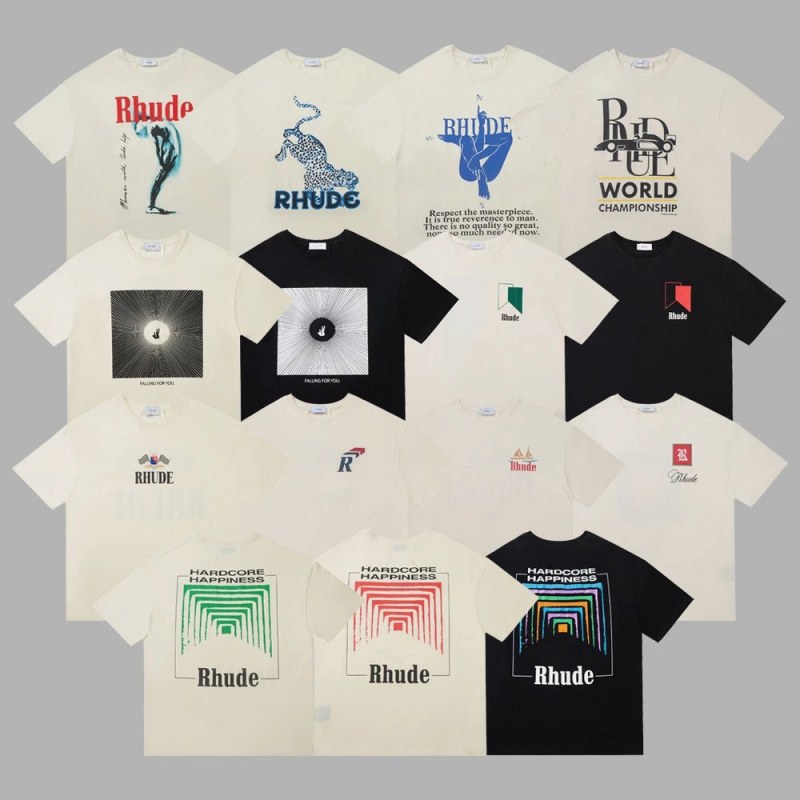
Both tees in this review came out of a mixed black-and-apricot order and went onto the bench before they went onto a body. Our desk photographs samples in a matte-black booth for beam and glare and a white booth for colour rendering, with the camera locked to a fixed white balance. A garment does not emit anything, so we used the booths the other way round: the same two source temperatures, 2700K and 5000K, aimed at the fabric to see how the print and the body colour separate. Then the tape measure and the laundry came out.
What we ordered
Two tees, RH236 in black and RH233 in apricot, at $8.36 each. That figure is one tee, not the assortment: the listing runs 42 option lines that resolve to 35 distinct RH codes, mostly black and apricot bodies with a handful of two-tone prints — RH201 in black-blue, black-yellow and white-green, and RH203 in apricot-green and apricot-red. Both samples are crew-neck pullovers in what the listing calls combed cotton, print decorated, cut loose, with a stated 1–3 cm measurement tolerance and sizes S through XXL. The listing shows the tee marked down from $9.20 and in stock.
One detail worth naming: the specification sheet describes the sleeve as a half or mid sleeve, while the English description says short sleeve. On our two samples the sleeve hem sat roughly two centimetres below the sleeve of a standard tee laid over the top. It is a short sleeve with a little extra length, not a three-quarter.
Flat measurements against the published chart
We measured the apricot size M flat, twice, on separate days, and averaged the readings.
| Measuring point | Our M sample | Published M chart row | Difference |
| Shoulder, seam to seam | 57.0 cm | 58 cm | −1.0 cm |
| Pit to pit, flat | 58.5 cm | 58 cm | +0.5 cm |
| Back length | 71.0 cm | 71 cm | 0.0 cm |
All three fall inside the 1–3 cm tolerance, which is the good news and also the warning. The published chart moves the chest about 3 cm between M and L but leaves the shoulder at 58 cm in both — the shoulder plateaus while the chest keeps growing. A tolerance that can reach 3 cm sitting on a 3 cm size gap means a large M can measure like a small L on the chest. Read the shoulder number and the back length, not the size letter.
There is a second problem with trusting any chart here. A separate Rhude-furnished table for a different tee lists a medium shoulder around 51 cm and a flat chest of roughly 52 cm — figures that sit far outside the tolerance this listing quotes, and likely describing a different line. Two tables under one brand name disagree by more than the margin the seller allows, so the garment on the unboxing bench is the only measurement that means anything.
Under 2700K and 5000K
The black body behaved the way black fabric always does on our bench: it absorbed almost everything the booth threw at it, and the ink edges of the lettering print stayed visually crisp because the contrast was already high. The apricot body was the interesting sample. Under a warm 2700K source it shifted clearly toward peach, and the separation between the print and the ground narrowed; under a neutral 5000K source it settled back to a light sand tone and the print read cleanly.
Neither body showed ink bleed through the shoulder seams or a visible halo where print met fabric. If the apricot is going to live under a warm lamp most of the day, expect the colour to look warmer in the room than it does in the listing photographs.
Five wash-and-dry cycles
Warm wash, low tumble dry, five rounds on the apricot sample. The print held: no flaking, no cracking along the letterforms, no lifted edges. The hand softened noticeably after the second cycle, which is what combed cotton does. Back length came in half a centimetre after the first wash and then stayed; the chest held within half a centimetre across the remaining four. That is a single-sample result on one colourway, and general Rhude discussion around heavy untreated cotton suggests shrinkage in the 3–5 percent range is normal for the fabric type, so treat our figure as one data point rather than a guarantee across all 35 codes.
Sizing: the buyer reports only look contradictory
Buyer discussion conflicts. Two reports advise sizing down because the body is boxy and slightly long; one reports a regular medium wearer needing an XL and notes that the smaller sizes feel tight around the bottom hem. Both can be true at once if the bottom hem is the binding constraint at the small end while the shoulder and drop govern everywhere else. The reported heavyweight hand that buyers praise for streetwear is consistent with the fabric description, though the listing itself only commits to a 180–250 g band rather than a single figure.
Our advice is to size by shoulder and back length first, hem circumference second, and ignore the letter on the tag. If you are between sizes and want the loose intended cut, the shoulder is where the difference shows up least — which is exactly why it is the wrong number to grow.
What we could not verify
We could not weigh the fabric to confirm where in the 180–250 g band these two tees actually sit, and we cannot say whether all 35 codes share the same hand. Colour names in the listing are code numbers, not photographs, so the print you receive is the print shown for that code and no other. Our score reflects two samples of one design family on a five-point scale, not the whole run.
The tee earns its price on the bench work: a print that survived five cycles, three flat measurements inside tolerance, and a sleeve that sits where the spec sheet says it does. What it will not do is forgive a size guessed from a letter.
Editor score 4.5 / 5
How we tested
Sources and notes
- Catalog product page
- Product listing verified on 2026-10-12.
Is the $8.36 price for one tee or the whole collection?
One tee. The listing's 42 option lines are individual colourway codes sold at $8.36 each, not a bundle. The two samples we ordered were billed separately at that price.
Will the 1–3 cm tolerance hide a size difference?
It can. The chest gap between M and L in the published chart is about 3 cm, the top of the tolerance band, so a large M could measure like a small L. Compare shoulder and back length too.
Does the spec call this a mid sleeve or a short sleeve?
Both, in different places. The spec sheet lists a half or mid sleeve while the English description says short sleeve. On our samples the sleeve hem sat about two centimetres lower than a standard tee.