On this page
If you apply the same size between regular tees and loose hoodies, it's easy to end up with a body that's too wide or a length that doesn't work. This cactus plant flea market hoodie's page shows a relaxed boxy cut, available in S–XL, listed as cotton, 350–400g, with a note that garment measurements may vary by about 2 cm. A more reliable way to choose a size is to
By Nathan ColeNathan Cole is Editor-in-Chief, covering residential and commercial lighting specification, LED driver behavior, illuminance and color measurement, and dimmer compatibility. They write most bulb and fixture reviews, keep the paper calibration log, and sign off on every final score. The bench protocol covers three illuminance distances, spectrometer readings at full, mid, and low dim, and a photodiode flicker run on the dimmer wall before scoring discussion. Every scored product requires a 30-day in-room period, and Nathan finalizes a score only when two of the three editors agree on the bench record.
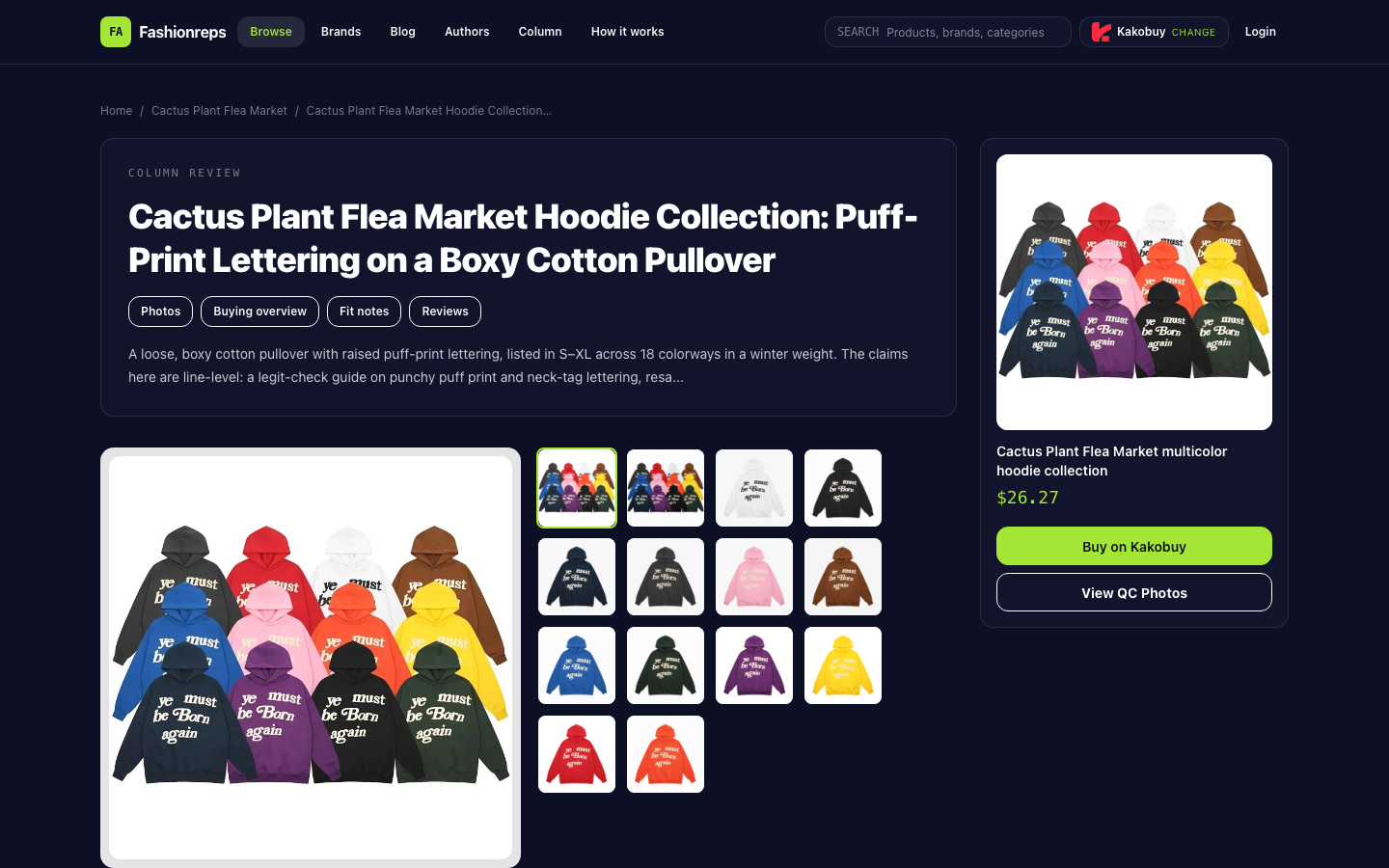
If you apply the same size between regular tees and loose hoodies, it's easy to end up with a body that's too wide or a length that doesn't work. This cactus plant flea market hoodie's page shows a relaxed boxy cut, available in S–XL, listed as cotton, 350–400g, with a note that garment measurements may vary by about 2 cm. A more reliable way to choose a size is to start with a hoodie you already own that fits well, then compare shoulder width, chest width, and body length.

Decide How Much Room You Want
This hoodie is not about a standard slim fit, but a loose, boxy silhouette. So when choosing, don't just ask "what size do I normally wear?" — first decide if you want to keep that extra horizontal space.
If you want the wide-shoulder, wide-body streetwear look, look for a size with shoulder and chest measurements close to a loose hoodie you already own; if you want it only slightly relaxed but not flaring out at the sides, don't blindly size up just for length. With a boxy cut, going up a size often increases not just length, but also shoulder and body width.
Step 1: Measure a Well-Fitting Hoodie
Take a hoodie you wear often and are happy with in both length and width. Lay it flat, smooth it out but don't stretch it, and record these three measurements:
- Shoulder width: from one shoulder seam to the other.
- Chest width: measure across the body under the armpits from side to side. Some pages call this body width or chest measured flat; make sure you're comparing the same method.
- Body length: from near the highest point of the shoulder to the hem. For hoodies with a hood, dropped shoulders, or no clear shoulder seam, the starting point can vary, so try to compare using the same method.
Write down the numbers, then compare them item by item with the size chart on the product page. Don't substitute your own body chest measurement for the garment chest width, and don't use T-shirt shoulder measurements as the standard for a hoodie.
Step 2: Use Shoulder and Length to Rule Out Sizes
Shoulder width determines whether the boxy silhouette looks natural. If the target size is much wider than your reference hoodie, you may end up with shoulder seams dropping too far, sleeves bunching, or an overall oversized look. If the shoulder is close but the length is noticeably shorter, the relaxed fit can make the upper body look proportionally short.
Follow this order:
- First, rule out sizes where the shoulder width is clearly beyond what you'd accept.
- Among the remaining sizes, compare body length to see if the hem covers where you want it to.
- Then check chest width to make sure there's still enough room to move.
- Finally, check sleeve length and hem ribbing; if the page doesn't provide these numbers, don't guess.
For this kind of boxy hoodie, shoulder and length are usually more useful than "do I wear S or M?" If you're between sizes, decide based on how much room you want, not by defaulting to the larger size.
What the Page Info Does and Doesn't Tell You
The page info we've verified supports this: the item is described as a cotton, 350–400g relaxed boxy hoodie. The page lists S–XL and 18 colors, and notes about a 2 cm measurement variance.
The page also mentions a used Medium example with shoulder about 66 cm, body width about 70 cm, and length about 66 cm. However, this data comes from a secondhand physical record, not a complete official size chart for this specific listing, so it's only a reference for the boxy direction, not a definite measurement for every size. The page also doesn't have detailed measurements for all colors and sizes.
So the safest approach is to treat these numbers as a "fit hint," not a buying basis. Always rely on the size chart and variant info shown on the current product page.
Pre-Order Checklist
When selecting size and color, go through this checklist:
- Confirm the current page still shows the color and size you want.
- Double-check that the color and size match the specific variant in your cart.
- See if the product page provides current shoulder, chest, and length measurements.
- Compare the page data with your own measured hoodie, allowing for about 2 cm variance.
- If the page is missing a measurement, don't substitute it with data from another color, batch, or secondhand record.
- Confirm the final item price, service fees, and international shipping through the page's purchase flow; don't infer these costs from the reference price alone.
Which Approach Works for You
If you want a clearly boxy, oversized fit and your current hoodie's shoulder and length are already close to the target, keep those numbers and use chest width to decide if you need more room.
If you care more about length, first check whether going up a size also increases shoulder and chest width. With a boxy cut, sizing up just for length may make the whole body wider than expected.
If you want a more regular hoodie proportion, or you don't like dropped shoulders and an overly wide body, this boxy direction described on the page may not be for you. Especially without a full size-by-size measurement chart, confirm actual measurements before ordering, rather than relying on the brand name or your usual T-shirt size.
Editor score 4.2 / 5