On this page
Establish the Overall Color Scheme First This outfit centers on gray and black, creating a clear visual relationship: the gray hoodie provides the main brightness, the black hooded jacket and joggers anchor the color scheme, and the second pair of gray joggers echoes the top's tone. This combination doesn't rely on complex colors, making it ideal for a simple, sporty-casual look or display composition. 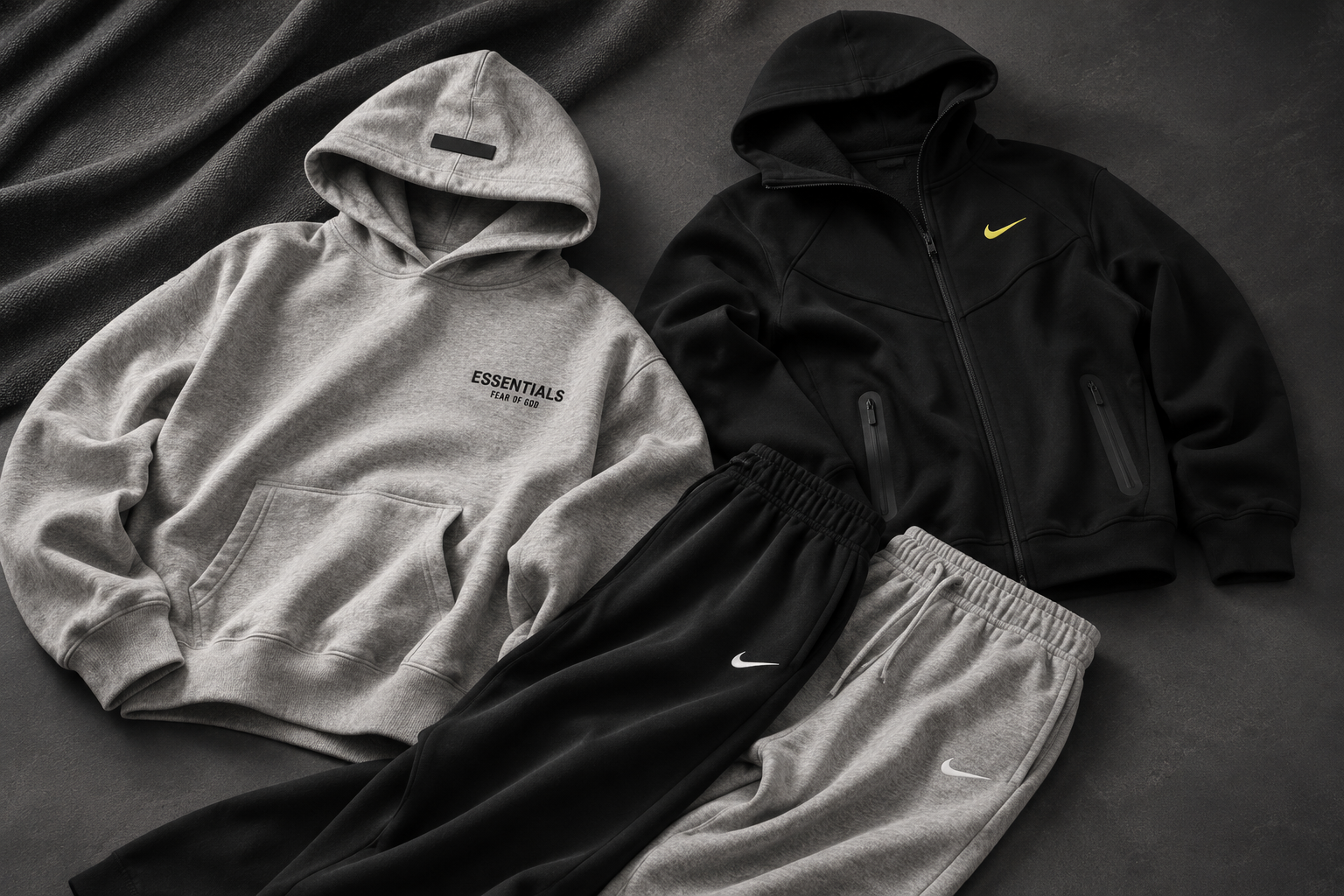
Establish the Overall Color Scheme First
This outfit centers on gray and black, creating a clear visual relationship: the gray hoodie provides the main brightness, the black hooded jacket and joggers anchor the color scheme, and the second pair of gray joggers echoes the top's tone. This combination doesn't rely on complex colors, making it ideal for a simple, sporty-casual look or display composition.

Color Coordination Suggestions
Pairing the gray hoodie with black joggers is the easiest way to maintain a sense of layering. The light gray top brightens the overall look, while the black pants keep the lower half sleek. If adding a black hooded zip-up jacket, continue using black as the outer layer, letting the gray hoodie peek through at the collar, hood, or front placket for a clear inner-outer contrast.
For a softer overall look, you can match the gray joggers with the gray hoodie, then use a black jacket or black accessories to anchor the palette. When wearing the same color top and bottom, it's best to create variation through different silhouettes and details—like the hoodie's kangaroo pocket, the jacket's zip pockets, and the joggers' waist drawstrings—to avoid a monotonous look.
The "ESSENTIALS FEAR OF GOD" lettering on the chest is the visual focal point of the gray hoodie. When layering with an outer jacket, avoid fully covering this area; for flat lay displays, position the lettering toward the center of the frame and keep the hood, hem, and cuffs visible.
How to Arrange a Flat Lay
For flat lays, start by choosing a main piece, then arrange other items as supporting elements. The gray hoodie works well as the central or left-side main item, with the hood spread upward, sleeves extending naturally to the sides, and the kangaroo pocket fully visible. The black jacket can be placed behind or to the side-back, showing only the hood, shoulders, and part of the zipper structure as a dark background layer.
Joggers work well placed diagonally across the frame. The black legs can serve as foreground lines, while the gray pants go beside or below, using the waist drawstring and side logos to add detail. Avoid fully overlapping the two pairs; otherwise the waistbands, pockets, or logos may be obscured. Keeping some independent silhouettes helps the viewer distinguish colors and styles.
Consider this sequence for display:
- Place the gray hoodie first to establish the main subject and direction.
- Add the black jacket, controlling the dark area so it doesn't overwhelm the gray top.
- Then lay out the black and gray joggers, letting the legs extend diagonally.
- Adjust the hoods, cuffs, hems, and waistbands so key structures remain visible.
- Keep logos and lettering facing the same reading direction to reduce visual clutter.
Styling Logic That Works
For a low-key, unified look, opt for the gray hoodie, black joggers, and black jacket. The black concentrates on the outer layer and bottom, with gray as an inner accent, creating a more streamlined effect.
For a more relaxed feel, pair the gray hoodie with gray joggers, then use the black jacket for contrast. In this case, avoid stacking all pieces in the same direction; instead, display the hoods, sleeves, and legs at different angles so the same-color garments still have clear outlines.
This set can be used to assess color relationships, flat lay composition, and visible details. From the image alone, you cannot determine size, fabric composition, inner construction, comfort, durability, or other unshown information, so styling choices should be based primarily on the visible colors, silhouettes, and display effect.
Editor score 4.2 / 5