On this page
Start with the sizing info on the page If you're looking at these Off-White style low-top sneakers, the page lists a size range of 35–42 and describes them as unisex lace-up lows. It also notes a leather upper, leather lining, rubber outsole, and 1–3 cm heel height. This only tells you the available sizes and construction—it doesn't prove a particular size will fit your foot. There are no independent buyer fit reviews for this specific item, and no complete i
By Nathan ColeNathan Cole is Editor-in-Chief, covering residential and commercial lighting specification, LED driver behavior, illuminance and color measurement, and dimmer compatibility. They write most bulb and fixture reviews, keep the paper calibration log, and sign off on every final score. The bench protocol covers three illuminance distances, spectrometer readings at full, mid, and low dim, and a photodiode flicker run on the dimmer wall before scoring discussion. Every scored product requires a 30-day in-room period, and Nathan finalizes a score only when two of the three editors agree on the bench record.
Start with the sizing info on the page
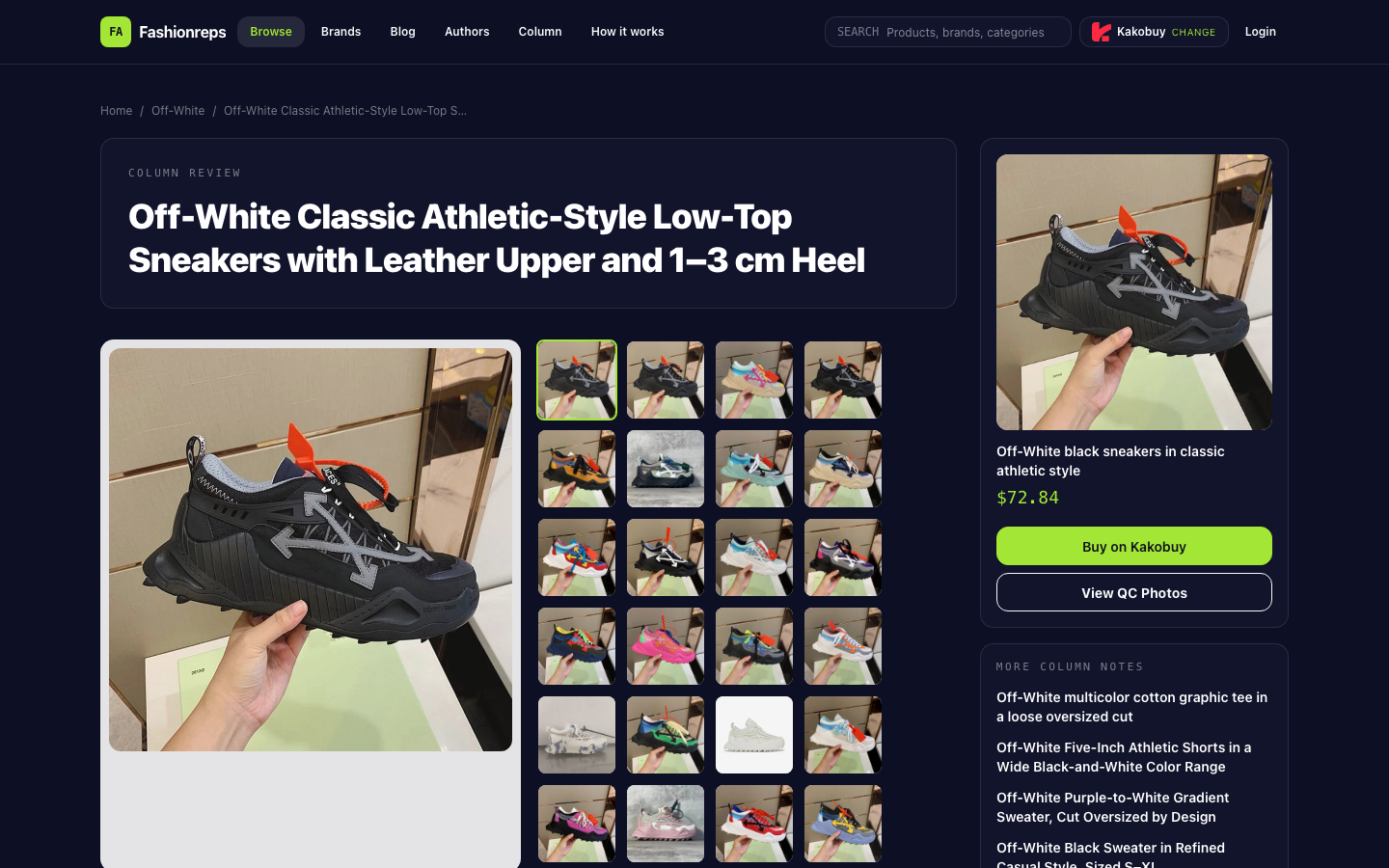
If you're looking at these Off-White style low-top sneakers, the page lists a size range of 35–42 and describes them as unisex lace-up lows. It also notes a leather upper, leather lining, rubber outsole, and 1–3 cm heel height.
This only tells you the available sizes and construction—it doesn't prove a particular size will fit your foot. There are no independent buyer fit reviews for this specific item, and no complete insole length or width measurements, so don't just order your usual size.
Narrow it down with foot length and width first
Measure in the afternoon or evening, when your feet are slightly larger than in the morning. Wear the socks you plan to use and stand while measuring:
- Put your heel against a wall with a piece of paper under your foot.
- Mark the tip of your longest toe and measure the length of both feet.
- Measure the width at the widest part of your forefoot.
- Use the larger foot as your reference.
- If your feet are different lengths, prioritize the longer one and adjust the other foot with laces or insoles.
Don't confuse the outsole length with the insole length. The outer sole includes edges, seams, and structural allowances, so it won't tell you the actual toe room.
Check with evidence, not just 35–42
The page lists 35–42, but the sizing notes aren't consistent: one note says non-Asian buyers, especially for a narrow fit, might need to size up; Asian buyers can consider their usual size. It also mentions uncertainty about whether to buy true to size.
So the range is just a first filter. Before ordering, confirm at least the following:
| What to confirm | What to ask the seller |
|---|---|
| Size system | Are 35–42 in European sizing or the shop's own chart? |
| Actual insole length | Insole length for each size, ideally in centimeters |
| Insole width | Usable width at the widest forefoot, and whether it runs narrow |
| Actual product | Does the shipped color, upper structure, and toe shape match the page? |
| Physical confirmation | Can they provide pre-shipment QC photos of the exact size and color? |
If the seller only says "order your usual size" but can't give specific insole measurements, it's still a low-confidence fit. Especially if you have wide feet, high arches, or a significant difference between your feet, wait for actual dimensions.
Assess risk by foot shape
If you have a standard foot shape and low instep, compare your foot length to the seller's insole length first, then check toe room. The page doesn't specify toe space for this model, so don't assume any size will fit perfectly.
If you have wide feet or a wide forefoot, focus on forefoot width and toe shape. Even if the length works, a narrow toe box can cause pinching. The note about possibly sizing up for a narrow fit doesn't replace measuring width, and it doesn't prove all colors and sizes use the same last.
If you have a high instep or wear thick socks, ask about the upper height and lacing adjustability. Lace-up construction gives some adjustment, but without volume data, treat it as unconfirmed.
Practical pre-order checklist
Follow this order:
- Record foot length and width for both feet; use the larger measurements.
- Confirm the seller's size system—don't assume it matches your usual chart.
- Ask for insole length and forefoot width for your size.
- Describe your foot shape: width, instep height, length difference, and sock thickness.
- Confirm the final color, size, and exact model.
- Request QC photos of the actual pair before shipping, checking size labels, left/right shoes, upper shape, and visible flaws.
- If size data is inconsistent, hold the order—don't just size up to cover missing info.
Interpreting the existing evidence for this shoe
The page clearly states there are no independent buyer reviews for this specific product. The durability issues mentioned come from other models of the same brand: one buyer reported the fabric lining of Out of Office trainers disintegrating after a few wears, and another reported receiving Off Court Low 3.0 with burn damage or defects and returning them. These reports don't prove the current low-top has the same issues, but they do call for QC checks and risk awareness.
Also, the page lists a reference price of $72.84 and another price of $87.28. Final item cost, service fees, and international shipping must be confirmed with the shopping agent—you can't calculate the actual total from these. Price doesn't substitute for sizing and physical evidence.
Conclusion: 35–42 is just a starting point
The page's size range is 35–42, but the existing evidence can't directly recommend a size for every foot shape. The safer approach: measure your larger foot's length and width, confirm the sizing system, insole length, forefoot width, and actual product, then verify size and shape with pre-shipment QC photos.
If the seller can't provide measurements, or if the advice on sizing up for non-Asian buyers is inconsistent, treat the order as high-uncertainty rather than assuming a bigger size will fix everything.

Article image
Editor score 4.2 / 5