On this page
Clarify the Purchase Task and Evidence Boundaries First If your goal is to find Loro Piana knitwear on fashion-reps suitable for fall/winter smart-casual office wear, answer three questions before buying: Does the product page clearly state the material? Is the size information sufficient to support selection? Can the images help determine the fit and suitability for the office commute? Only when this information is basically complete should you pr
By Nathan ColeNathan Cole is Editor-in-Chief, covering residential and commercial lighting specification, LED driver behavior, illuminance and color measurement, and dimmer compatibility. They write most bulb and fixture reviews, keep the paper calibration log, and sign off on every final score. The bench protocol covers three illuminance distances, spectrometer readings at full, mid, and low dim, and a photodiode flicker run on the dimmer wall before scoring discussion. Every scored product requires a 30-day in-room period, and Nathan finalizes a score only when two of the three editors agree on the bench record.
Clarify the Purchase Task and Evidence Boundaries First
If your goal is to find Loro Piana knitwear on fashion-reps suitable for fall/winter smart-casual office wear, answer three questions before buying: Does the product page clearly state the material? Is the size information sufficient to support selection? Can the images help determine the fit and suitability for the office commute? Only when this information is basically complete should you proceed to the ordering process.
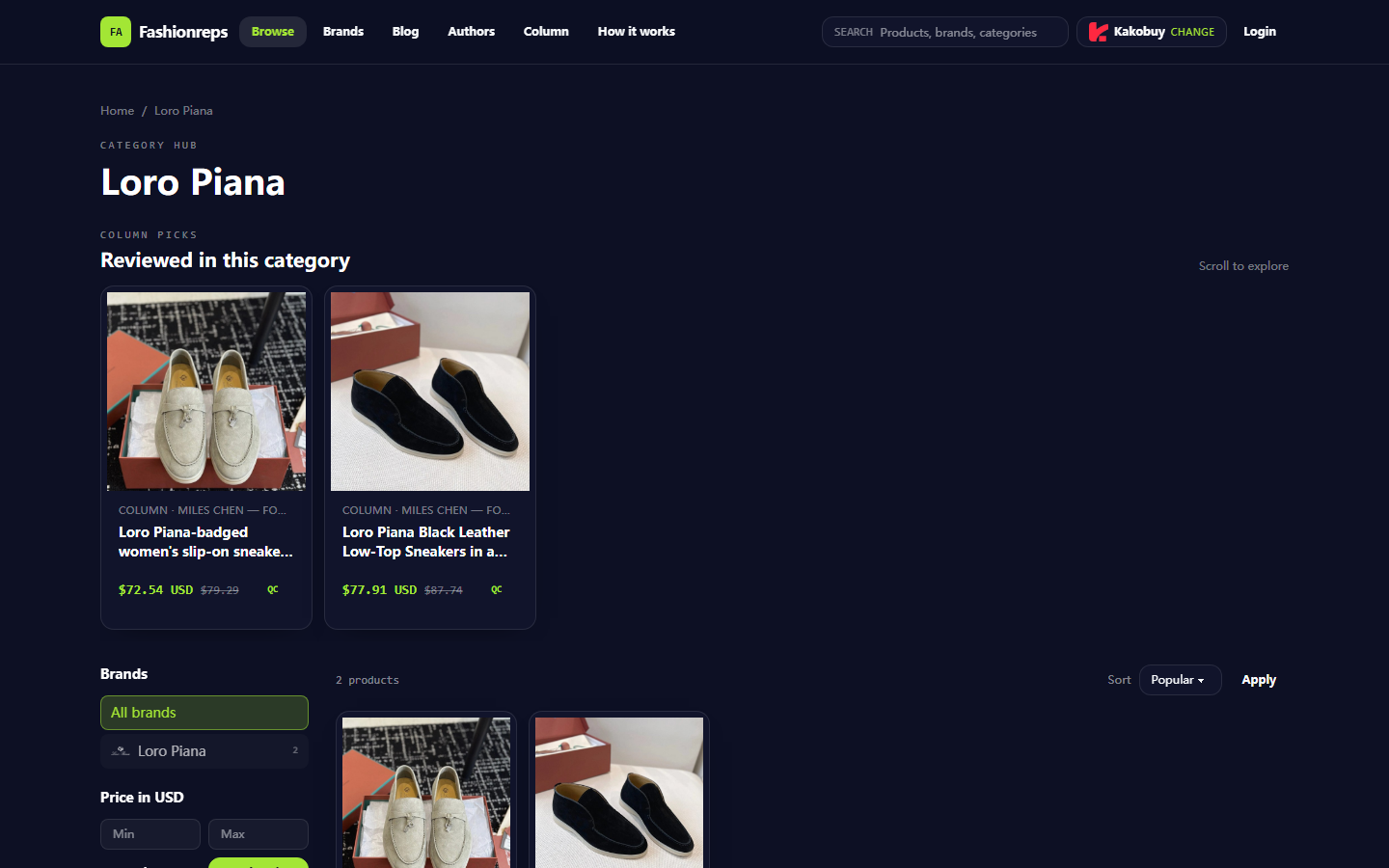
There are no Loro Piana knitwear product samples available for verification in the current materials; the existing page evidence is a Loro Piana shoe category page. Therefore, this article will not transcribe prices, sizes, or image observations from the shoe page into knitwear facts, nor will it speculate about knitwear stock, fabric composition, or actual fit. 🧾
This article applies to: buyers who have already found candidate knitwear and are preparing to compare product page information.
This article does not apply to: cases where you need to confirm authenticity, require judgment of actual hand feel, or want current stock or final shipping quotes. These issues must rely on complete product pages, real-time order information, or professional verification with appropriate permissions.
Record Style, Color, Size, and Visible Specs from the Product Page
After opening the candidate product page, first save the page title, product category, color options, size options, price display, product images, and page update time. Do not record only the short title from search results, because search results may omit material, fit, or size restrictions.
Record in the following order:
- Product name: Keep the original page text, and note whether it includes the collection name, style name, or gender classification.
- Product category: Confirm that the page indeed belongs to knitwear, sweater, cardigan, or another clear category.
- Color: Record the specific colors listed on the page, not just names based on image colors.
- Size: Copy the available sizes and corresponding measurements such as chest, length, shoulder width, sleeve length; mark as missing if no data is provided.
- Specs: Record the material, thickness, collar type, knit pattern, closures, and care information explicitly stated on the page.
- Images: Distinguish between main product images, detail images, size charts, and suspected real-life photos; do not treat image style as proof of material.
- Link status: Confirm that the page opens normally and still displays the product name and sufficient visible information.
fashion-reps pages are closer to product discovery and review entry points. Available materials show that the buy button on the page leads to a shopping agent selected by the user, and order, payment, and logistics are handled by the agent's website. Therefore, the reference price on the product page cannot be equated with the final payment amount including shipping, taxes, and after-sales costs. 💳

Figure: Category page illustration. The currently available screenshot shows a Loro Piana shoe page and cannot be used as evidence of knitwear material, size, or smart-casual office suitability.
Cross-Check Material Description, Size Info, and Images for Consistency
The first principle of material verification is to separate page facts from editorial judgment. When the page explicitly states "cashmere," "wool," "cotton," or blend ratios, it can be treated as a product page description to be verified; if it only says "premium fabric," "soft feel," or similar promotional language, it cannot be converted into specific fiber content.
Size information also needs to be checked separately. A usable size chart should at least specify measurement items, units, and size correspondence. If the page only provides letters like S, M, L without actual measurements, buyers cannot reliably determine whether shoulder line, chest, and length are suitable for layered office wear.
Pause your purchase when images and text show the following situations:
- The page text says knitwear, but the images mainly show shoes or other categories.
- The text lists a certain fiber, but the images and description have no fabric details or composition labels for cross-checking.
- The size chart clearly does not match the fit in product images, but the page does not explain the measurement method.
- Different images show different collar types, cuffs, colors, or decorations, and the page does not state whether there are multiple versions.
- Images only show distant model shots, making it impossible to observe stitching, thickness, neckline, hem, and inner structure.
- There are conflicts between product title, category, images, and options.
Do not judge whether it is cashmere, wool, or other material based solely on sheen, drape, or model styling. Images can at most help observe visible structure, but cannot prove hand feel, warmth, pilling resistance, or actual fiber ratio. 🔍
Analyze Suitability by Commute, Indoor Office, and Outer Layering Scenarios
Whether knitwear is suitable for the office commute depends not only on brand name or color, but also on thickness, fit, collar type, ease of movement, and compatibility with outerwear. After the product page information is complete, you can judge from the following perspectives:
When layering with outerwear on the commute, prioritize checking whether there is enough room in the shoulders, whether cuffs stack easily, and whether the length will visibly conflict with trouser or skirt waistbands. Without these detail images, you can only list "suitable for layering" as a pending item.
Indoor office environments usually place more emphasis on collar comfort, cuff tightness, and length when seated. High collars, loose drop shoulders, or thick knit structures may require more styling space, but you cannot directly judge whether it will feel stuffy or restrict movement without size and thickness data.
For outer layering, check the volume relationship between the knitwear and coat, jacket, or scarf. Light colors, fine knits, and obvious fuzzy textures may be more prone to pilling, snagging, or stains, but this is only a question to raise at purchase, not a quality conclusion about an unverified product.
If the product page lacks front, side, back, and detail images, it is recommended to limit the smart-casual office suitability evaluation to "whether the information is sufficient to make a decision," rather than drawing conclusions for the product. 🧥
Distinguish Page Facts, Image Observations, and Editorial Judgment
Use three layers of evidence to organize candidate products and avoid writing speculation as fact:
| Evidence Level | What Can Be Recorded | Conclusions That Should Not Be Directly Drawn |
|---|---|---|
| Explicit page text | Material name, size options, color names, style category, page price | Actual fiber ratio, actual stock, final landed cost |
| Visible image information | Collar type, cuffs, color presentation, partial structure, whether images are clear | Hand feel, warmth, durability, authenticity |
| Editorial judgment | Whether information is sufficient, whether to continue verification, questions to confirm with agent | Personal wearing experience, actual purchase result, guaranteed promises |
Editorial judgment should use expressions like "recommend verifying," "page does not show," "currently unable to confirm." Do not use unverified statements like "personally tried on," "tested softness," "guaranteed authentic," or "definitely suitable for all office commute scenarios."
Build a Pre-Purchase Verification Checklist
Before selecting a size or entering the agent's order page, it is recommended to complete the following records:
| Verification Item | Passing Condition | Action if Missing |
|---|---|---|
| Product category | Page clearly belongs to the target knitwear category | Pause and request the correct product page |
| Material description | Clear composition or at least explicit material description | Don't treat promotional words as composition; confirm with agent |
| Size information | Actual measurement items, units, and corresponding sizes | Pause size selection; avoid buying based only on letter sizes |
| Color information | Color options basically consistent with images and text | Request confirmation of specific version or color code |
| Detail images | Can see collar, cuffs, hem, and overall fit | Mark smart-casual office suitability as unconfirmed |
| Page status | Page accessible, title and specs still visible | Do not order based on search snippets or cached content |
| Cost information | Agent page can display item price, service fee, and shipping options | List taxes, shipping, and exchange rate as pending |
Page price, stock, agent service fees, route restrictions, and shipping costs may change. Record the verification date, destination country, and currency before publishing or ordering; current materials are insufficient to provide real-time price or stock conclusions for any specific knitwear. 📅
Pause Conditions When Specs Are Missing, Images Insufficient, or Information Conflicts
Do not pay directly if any of the following situations occur:
- Product name does not match the category.
- No actual size data, yet the buyer is required to guess the size.
- Material described only with vague marketing terms, no verifiable composition information.
- Color options cannot be matched to image versions.
- Page lacks enough images to judge collar type, cuffs, thickness, or overall length.
- Agent page and product page show inconsistent prices, options, or links.
- Product page has been redirected, returned empty, shows 404, or only a tag list remains.
Pausing does not mean the product necessarily has quality issues, but that evidence is insufficient to support the next decision. Save page screenshots and candidate information, then ask the shopping agent about specific styles, available sizes, measurement methods, available warehouse inspection photos, and return/exchange conditions. Do not submit passports, full payment card information, or public screenshots containing personal addresses. 🔒
Next Action Checklist After Completing Style Selection
- Confirm the product page is still accessible, and record the verification date, destination country, and currency.
- Confirm the page belongs to knitwear, not another category page of the same brand.
- Save color, size, and all visible specs, marking missing fields.
- Request actual measurement data, prioritizing chest, shoulder width, length, and sleeve length.
- Cross-check images for consistency in collar type, cuffs, hem, color, and style.
- Enter the selected shopping agent via the page's buy button, and re-check product options and price.
- Before payment, confirm service fees, shipping fees, applicable tax conditions, return window, and warehouse inspection scope.
- After receiving warehouse photos, check only visible evidence for color, size labels, obvious structure, and damage; do not treat photos as proof of material or authenticity.
- If key fields are still missing, keep the candidate record and pause the order; do not use guesses to replace verification.
The final judgment should be "whether evidence is sufficient to support purchase," not "whether the page looks premium." In current materials, Loro Piana knitwear still lacks verifiable product samples for material, size, color, stock, and smart-casual office suitability, so a safer next step is to wait for a complete knitwear product page with size, specs, and detail images before making a selection.
Editor score 4.2 / 5