On this page
When organizing Dallas Mavericks jersey candidates, the easiest mistake isn't copying products into a spreadsheet—it's mistaking different styles, numbers, or name print variants from the same source as multiple separate products. A more reliable approach is to first confirm the candidate range in the Fashionreps catalog, then go back to the product pages to verify style evidence, and finally use Google Sheets to tr
By Nathan ColeNathan Cole is Editor-in-Chief, covering residential and commercial lighting specification, LED driver behavior, illuminance and color measurement, and dimmer compatibility. They write most bulb and fixture reviews, keep the paper calibration log, and sign off on every final score. The bench protocol covers three illuminance distances, spectrometer readings at full, mid, and low dim, and a photodiode flicker run on the dimmer wall before scoring discussion. Every scored product requires a 30-day in-room period, and Nathan finalizes a score only when two of the three editors agree on the bench record.
When organizing Dallas Mavericks jersey candidates, the easiest mistake isn't copying products into a spreadsheet—it's mistaking different styles, numbers, or name print variants from the same source as multiple separate products. A more reliable approach is to first confirm the candidate range in the Fashionreps catalog, then go back to the product pages to verify style evidence, and finally use Google Sheets to track links, variants, and items pending review.

First, define the scope of this organization
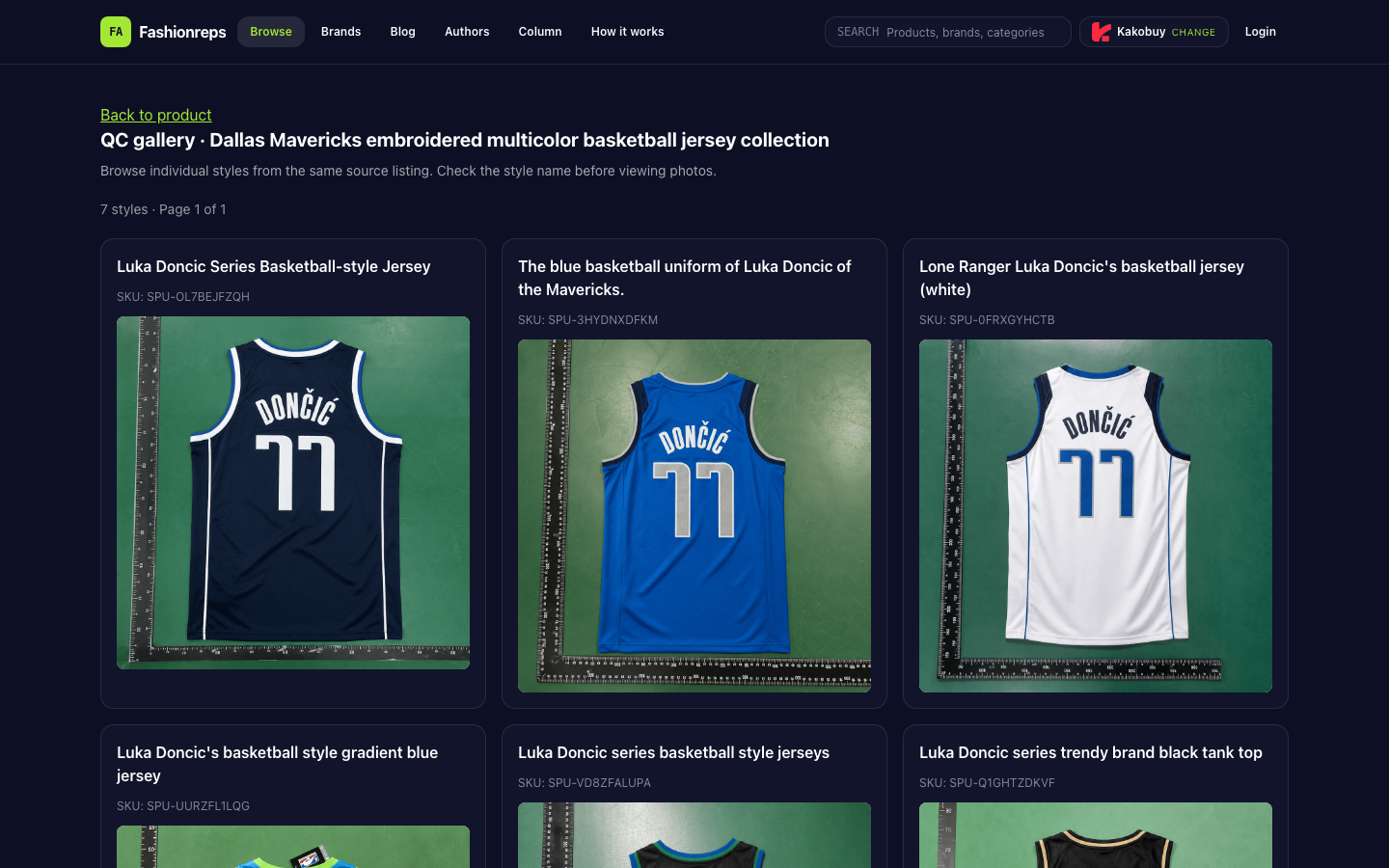
This review covers the Dallas Mavericks embroidered multicolor basketball jersey collection QC page on Fashionreps. The page shows that the source contains 7 styles, but this does not mean 7 completely separate product pages, nor can it be used to infer inventory, price, size availability, or purchase results.
The style names and SKUs listed on the page include:
- Luka Doncic Series Basketball-style Jersey, SKU: SPU-OL7BEJFZQH
- Lone Ranger Luka Doncic's basketball jersey (white), SKU: SPU-3HYDNXDFKM
- Luka Doncic's basketball style gradient blue jersey, SKU: SPU-0FRXGYHCTB
- Luka Doncic series basketball style jerseys, SKU: SPU-UURZFL1LQG
- Luka Doncic series trendy brand black tank top, SKU: SPU-Q1GHTZDKVF
- Luka Doncic's No. 77 blue-green basketball jersey, SKU: SPU-9CWC2VJNBV
The source text shows 7 styles, but the listed style names and SKU information do not correspond perfectly; at least one style name is missing a visible SKU. Therefore, the spreadsheet should keep a "pending confirmation" status rather than filling in or guessing on your own.
What the catalog page and Google Sheets are each responsible for
The Fashionreps catalog is good for discovering candidates and going back to the original page to re-check images, names, and page entry. It preserves the product's original context, making it suitable for determining whether a style belongs to the same source collection.
Google Sheets is better for turning review results into a filterable, trackable list. For example, you can filter by status to find all records that need screenshots, or sort by SKU to check whether the same product is listed twice. It is an organization and collaboration tool, not a substitute for original page evidence, and it cannot automatically prove that a product is currently purchasable.
| Review objective | Catalog page | Google Sheets |
|---|---|---|
| Discover candidate styles | View collection page and style list | Record candidate names |
| Verify product identity | Go back to original page to view name, image, and SKU | Save review conclusions and evidence notes |
| Handle duplicate records | Compare with source page to determine if same collection | Filter by SKU, name, and original link |
| Track anomalies | Check if page still opens | Mark pending confirmation, link needs review, or duplicate record |
Fields recommended to set up
Do not start by adding price, inventory, or shipping fields with guessed values. First establish a minimal set of fields that support identity verification:
- Product collection name
- Style name shown on page
- SKU
- Team or series identifier
- Color description
- Number or name print
- Detail page entry
- Original link
- Page opens
- Product identity correspondence
- Variant pending confirmation
- Link needs review
- Duplicate record
- Evidence notes
- Last review time
Among these, "number or name print" should be recorded separately from the actual page text. For example, the No. 77 blue-green jersey can have 77 in the number field and blue-green in the color field; you cannot automatically fill all records with the same number or name variant just because "Luka Doncic" appears in other style names.
Steps to enter candidates
Step 1: Create initial records from the collection page
First, enter the style names and SKUs exactly as shown on the page, without rewriting them into uniform marketing titles. Keeping the original text helps later discovery of spelling differences, duplicate names, and missing fields.
Multiple records from the same collection can share the collection name, but each record should retain its own style name and SKU. If the page does not show a field, write "not shown" or "pending confirmation"; do not fill in based on images or common sense.
Step 2: Separate product identity and variant information
Product identity answers "Is this the same record from the same source?", while variant information answers "Which color, number, or name print is it specifically?" These two questions should use different columns.
For example, Luka Doncic's No. 77 blue-green basketball jersey can be broken down into at least:
- Style name: page original text
- Number: 77
- Color: blue-green
- Name or player identifier: Luka Doncic
- Identity status: needs further verification on detail page
If another record only says "Luka Doncic series basketball style jerseys" and the page does not specify a number or color, leave those fields blank and mark "variant pending confirmation."
Step 3: Save detail page review results
After opening the detail page, focus on checking the page name, SKU, style in the images, and whether the page still loads properly. Write your observations into the evidence notes, and record the statuses separately:
- Page opens: page can be accessed normally
- Product identity correspondence: name, SKU, or image matches the candidate record
- Variant pending confirmation: style, color, number, or name information is missing
- Link needs review: entry link broken, redirect issue, or insufficient page information
- Duplicate record: possibly points to the same style or same original link as an existing record
"Page opens" does not mean "product identity correspondence," and "product identity correspondence" does not mean currently in stock or available for purchase. Keeping these statuses separate helps avoid mistaking page accessibility for a purchase conclusion.
Use the spreadsheet to find duplicates and conflicts
In Google Sheets, you can first sort by original link, then by SKU. If multiple rows have the same link, check whether they are just different display records from the same collection page; if the SKU is the same but the style name differs, go back to the source page to see if there is a name variant or entry error.
The following judgment order can be used:
- Same original link, first mark as "duplicate record pending review."
- Same SKU but different name, keep the original text and check the detail page; do not merge directly.
- Similar names but different SKUs, temporarily keep as separate candidates.
- Only color, number, or name information differs, confirm whether the page clearly treats them as different styles.
- If the page does not provide enough evidence, keep both records and mark "variant pending confirmation."
The point of this is not to reduce rows as quickly as possible, but to ensure that every merge has source basis. Merging too early loses style differences; deleting too early may make the original records unrecoverable.
What to do when catalog and detail page fields conflict
If the collection page name, detail page name, and image content do not match, do not simply choose the version that seems more reasonable. It is recommended to follow these steps:
- In the evidence notes, separately record the original text from the collection page and the detail page.
- Save screenshots or page records that show the conflicting fields.
- Mark the product identity as "pending confirmation," not as matched.
- Temporarily refrain from recommending that record as a definite style.
- During follow-up review, prioritize checking whether the SKU, original link, and page image point to the same record.
The source verified so far supports the style names, some SKUs, and the fact that the page belongs to a 7-style collection, but it cannot support price, inventory, size, shipping, quality, or actual purchase results. Therefore, these fields should be left blank or explicitly marked as "not verified."
Final checklist
Before submitting the organized results, you can check in the following order:
- Each record retains the page's original name.
- SKUs are not filled in based on names.
- Numbers, colors, and name prints are not mixed in the same field.
- Duplicate records with the same original link have been checked.
- "Page opens" and "product identity correspondence" are not combined into one conclusion.
- Records with missing variant information are marked pending confirmation.
- Unverified price, inventory, size, shipping, and quality are not written as facts.
- Records with conflicts between detail page and collection page have evidence notes.
After completing these checks, Google Sheets is no longer just a list of product names, but a candidate catalog that can explain "where records come from, which fields have been verified, and which issues remain unresolved." For this set of Dallas Mavericks jerseys, the most important result is not to forcibly confirm all variants, but to accurately distinguish between information already shown, information pending review, and information that cannot be inferred from the current source.
Editor score 4.2 / 5