On this page
## Who This Is For and Evaluation Scope This evaluation is for buyers who want to verify winter jacket details and are concerned about layering knitwear or [hoodies](https://fashion-reps.net/hoodies) without feeling too tight. The goal is not to directly judge whether the product is warm or suitable for all weather, but to help you decide whether to request size information, additional QC photos, or hold off on purchasing based on visible evidence on the product page. The sample reviewed in this
By Nathan ColeNathan Cole is Editor-in-Chief, covering residential and commercial lighting specification, LED driver behavior, illuminance and color measurement, and dimmer compatibility. They write most bulb and fixture reviews, keep the paper calibration log, and sign off on every final score. The bench protocol covers three illuminance distances, spectrometer readings at full, mid, and low dim, and a photodiode flicker run on the dimmer wall before scoring discussion. Every scored product requires a 30-day in-room period, and Nathan finalizes a score only when two of the three editors agree on the bench record.
Who This Is For and Evaluation Scope
This evaluation is for buyers who want to verify winter jacket details and are concerned about layering knitwear or hoodies without feeling too tight. The goal is not to directly judge whether the product is warm or suitable for all weather, but to help you decide whether to request size information, additional QC photos, or hold off on purchasing based on visible evidence on the product page.
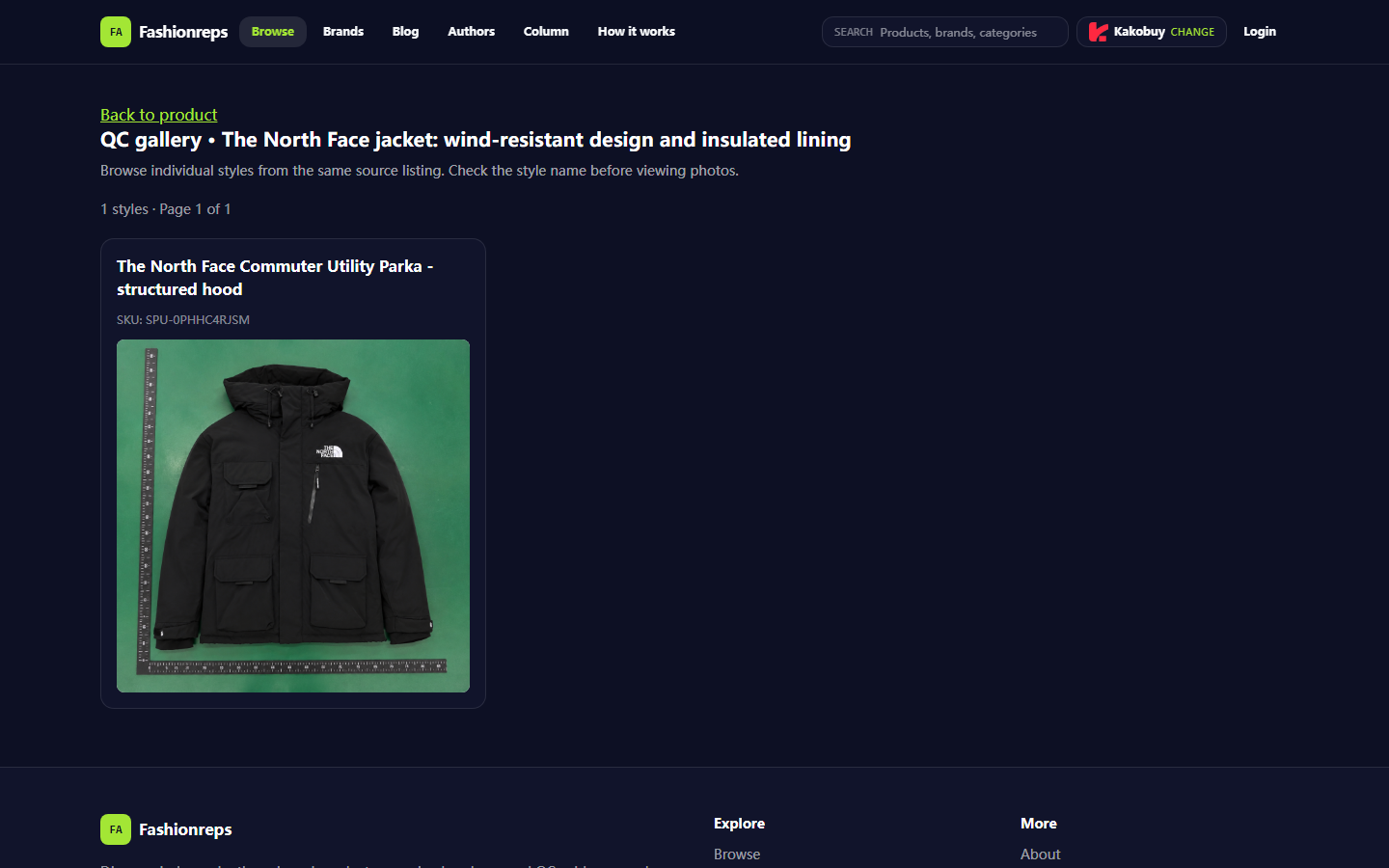
The sample reviewed in this article is The North Face Commuter Utility Parka - structured hood from a Fashionreps product page, listed as 1 style. The related QC page title mentions wind-resistant design and insulated lining, but currently available information does not provide lining composition, weight, down fill, fill ratio, collar measurements, or a complete size chart. Therefore, the following sections will separate page facts, observable structure, and editorial judgment.

Image: Screenshot of the QC page for the Fashionreps product sample, focusing on structural information rather than using images as a substitute for material or wear testing.
Information on the fashion-reps.net Product Page: Lining, Collar, and Fit
The confirmed facts from the current sample page are:
- Product name: The North Face Commuter Utility Parka - structured hood.
- The page displays 1 style; it is advisable to confirm the specific style name you are viewing.
- The QC page title uses descriptions like "wind-resistant design" and "insulated lining," but this does not equate to confirmed specific fabric, fill parameters, or actual warmth level.
Fashionreps is positioned to help users discover products, view independently organized product and QC evidence, and compare external shopping agents. The purchase button on the page redirects to the user's chosen agent platform, and orders, payments, and logistics are handled by the agent platform's website. Therefore, this article does not misrepresent page browsing as a purchase, receipt, or personal try-on, nor does it treat product page information as an after-sales promise from the agent platform.
If you are ready to continue verification, prioritize requesting the following from the product page or agent platform:
- Actual measurements of chest, body length, shoulder width, sleeve length, and hem circumference.
- Text description of lining material, fill, or interlining structure.
- Collar height after zipping, and whether the hood can be tightened independently.
- Whether the placket has a wind flap, snaps, or hidden zipper.
- QC photos for different sizes, especially collar, underarm, cuff, and hem areas.
These details are more suitable for judging layering room than vague labels like "winter style" or "warm style."
How to Record Lining Material and Structure Details Systematically
When recording, do not just copy the product title. Keep separate records of what the page explicitly states, what is visible in images but not confirmed by text, and what is completely missing.
| Check Item | Currently Recordable | Still Needs Confirmation |
|---|---|---|
| Lining | Page title mentions "insulated lining" | Material, thickness, weight, fill ratio, and feel not confirmed |
| Outer function | QC page title mentions "wind-resistant design" | Fabric composition, coating, seam sealing, and waterproof rating not confirmed |
| Fit | Product name includes "structured hood," indicating the page highlights structured hood as identification | Shoulder width, chest, armhole, and hem circumference not confirmed |
| Number of styles | Page shows 1 style | Should verify if the agent page corresponds to the same style |
When the product image shows "has lining," you can record it as "visible inner layer structure in image." Do not go further and write "soft," "thick," "fluffy," or "comfortable to wear" unless the page provides reliable description or verifiable measurement evidence. 👀
If the page only has flat lay photos without cross-section or close-up shots, it is recommended to list "whether the lining covers the entire body," "whether sleeves have a separate inner layer," and "whether underarms are reduced" as items to confirm. The tightness of winter layering often comes from the armhole, shoulder, and underarm, not just the body thickness.
Visible Design at Collar, Placket, and Hood Connection
"Structured hood" can help buyers focus on the connection between hood and collar, but it does not prove the hood has good wind resistance, support, or adjustability. When checking images, observe in the following order:
- Whether the collar covers up to the chin area when zipped.
- Whether there is a protective flap at the top of the zipper to avoid direct friction with the chin.
- Whether there is obvious stacking or gaps at the hood-collar junction.
- Whether the hood edge has drawstrings, toggles, or other visible adjustment structures.
- Whether the placket covers the main zipper, and if there are snaps, Velcro, or a second wind flap.
- Whether there are obvious protrusions, exposed stitching, or thick overlapping areas inside the collar.
These observations can only be used to raise questions and cannot replace actual wear testing. For example, a high-looking collar does not mean it will not dig into the chin when fully zipped; a supportive-looking hood does not mean it will stay in place when worn. 🧥
If you need the jacket for daily commuting rather than extreme cold, the fit room for collar and hood layering is usually more important than simply pursuing "thicker and warmer." When high-neck knitwear, scarves, and hoods are layered together, the most common issues are restricted neck movement and inability to fully zip up.
What to Check When Layering with Knitwear or Hoodies
First determine your actual inner layer, then compare with the jacket's actual measurements. Do not infer the correct size based solely on your usual size, and do not look only at body length.
When wearing knitwear, focus on checking whether there is enough movement room in the shoulders, armholes, and chest. Knitwear may not be thick, but cuffs, shoulder seams, or high collars can add local volume. When wearing a hoodie, test with the hood inside the jacket hood or outside separately, as the two placements change the amount of bulk at the back neck and collar.
Follow this sequence to check:
- Measure the chest, shoulder, sleeve length, and body length of your most-worn knitwear or hoodie.
- Compare these data with the jacket's actual measurements at the same positions, not just the label size.
- Focus on whether there is sufficient movement room in the underarm and shoulder.
- Simulate fully zipping up and check if high collars, scarves, or hoods press against the chin.
- Simulate raising arms, reaching forward, and wearing a backpack to confirm cuffs and hem do not ride up significantly.
- If the product page lacks actual measurements, request them from the agent or seller before deciding size.
The judgment can be simply divided into three categories:
- Complete information and clear size allowance: proceed to check price, stock, agent fees, and destination country shipping conditions.
- Product images available but no measurements: can only do initial structural screening, not advisable to order directly.
- Missing collar, armhole, and lining information: hold off purchase to avoid treating vague "winter" descriptions as fit evidence.
📏 The core of this step is not to find a universal size, but to confirm whether your inner layers, movements, and collar space can all work together.
Warmth and Comfort That Cannot Be Inferred from Product Images
Product images and QC photos can help verify appearance, stitching, zippers, hood attachment, and obvious structure, but cannot reliably prove the following:
- Actual warmth level or suitable temperature.
- Whether the lining is soft, itchy, or prone to static.
- Whether the fill is evenly distributed or clumps after long wear.
- True performance of the fabric in rain or snow.
- Durability of zippers, snaps, and drawstrings after multiple uses.
- Comfort when using a hood, scarf, and backpack simultaneously.
Therefore, do not expand the windproof or insulated descriptions in the page title into "suitable for extreme cold," "waterproof," "all-weather," or "guaranteed comfort." If your destination has cold, wet winters, strong winds, or requires prolonged outdoor activity, additionally verify fabric descriptions, fill parameters, seam sealing, and actual after-sales policy. 🌨️
Also note that brand names and product page descriptions do not automatically prove the product's source, authorization status, or authenticity. This article only evaluates whether the page information is sufficient to support further verification, and does not guarantee brand authenticity, nor does it use unverified conclusions like "genuine," "guaranteed," or "best."
Separating Page Facts, Community Feedback, and Editorial Judgment
Page facts are the current sample name, number of styles, and the wind-resistant design and insulated lining descriptions from the QC page title. Visible images can be used to check whether the structure is clearly shown, but images themselves are not material testing or wearing experience.
Community feedback needs to have source, posting time, comment context, and readability recorded separately. This article does not treat unverified community evaluations, star ratings, or single comments as conclusions, nor does it claim a consistent user experience. If comments appear later, first determine whether the discussion is fully readable, then distinguish long-term common issues, individual complaints, and logistics issues unrelated to size.
Editorial judgment is an action recommendation based on evidence: the current page is suitable for initial structural screening, but the information is insufficient to independently support conclusions about warmth, comfort, size, or durability. The focus of this judgment is not to negate the product, but to avoid premature ordering when key data is missing. ✅
Final Action: Use an Evidence Checklist to Decide on Further Verification or Holding Off
Before continuing verification, complete this checklist:
- [] Confirm that the agent page corresponds to The North Face Commuter Utility Parka - structured hood, not other styles from the same source page.
- [] Obtain actual measurements for chest, shoulder, sleeve length, body length, and hem circumference.
- [] Inquire about lining material, fill information, and interlining coverage.
- [] Get close-up photos of collar zip, hood connection, armhole, and underarm.
- [] Calculate layering allowance using measurements of your frequently worn knitwear or hoodie.
- [] Separately verify product price, stock, agent service fee, international shipping, destination taxes, and return/exchange conditions; these should be reconfirmed before ordering according to your destination and verification date.
- [] Do not submit passport, full shipping label, payment card, or other unnecessary personal information to unknown sources.
If supplementary information can prove the jacket has enough room in shoulders, armholes, chest, and collar, then it is more suitable for those needing daily commute layering to further evaluate. If only general descriptions like "windproof" and "insulated lining" are visible and size and structural details cannot be obtained, holding off purchase often reduces risks of wrong size, difficult returns, and extra shipping costs.
This cautious approach may cost you more time communicating and even miss short-term stock; the benefit is reducing risks of buying the wrong size, limited layering, or mistaking promotional descriptions for measured performance. It suits buyers who value commuting layering room and are willing to verify evidence first, not those who already have complete measurements and just need a quick purchase.
Editor score 4.2 / 5